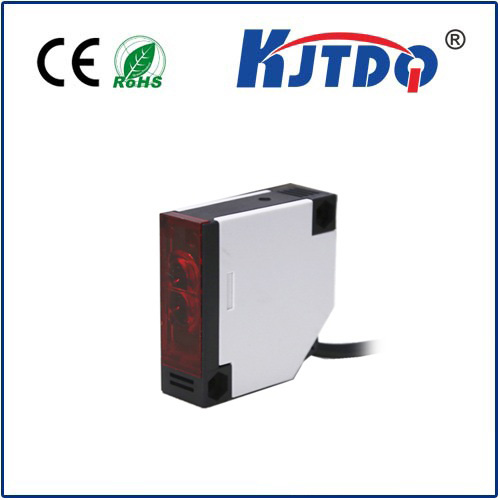
In the realm of industrial automation, photoelectric sensors are indispensable components for detecting the presence, absence, or distance of objects without physical contact. Their reliability and versatility make them a cornerstone of modern manufacturing, packaging, and material handling systems. A critical aspect of selecting the right photoelectric sensor for your application involves understanding its output configuration, specifically the distinction between PNP and NPN transistor outputs. This choice is not merely a technical detail but a fundamental decision that impacts system compatibility, wiring, and overall control logic.
At its core, a photoelectric sensor operates by emitting a light beam (visible red, infrared, or laser) and detecting changes in the received light. When an object interrupts or reflects this beam, the sensor's internal circuitry triggers a switching action. This is where the output transistor comes into play. The sensor itself is a "sourcing" or "sinking" device based on this output type, which defines how the electrical current flows to signal a state change to the controller, typically a Programmable Logic Controller (PLC).
A PNP output sensor is often described as "sourcing." In its active state (when the detection condition is met), the PNP transistor switches on, connecting the output signal line to the positive supply voltage (+V). This means it *sources* current *from* the positive supply *to* the load (e.g., the PLC input). Imagine the sensor acting as a switch that provides the positive power. Consequently, the load is connected between the sensor's output wire and the common negative (0V) of the power supply. PNP sensors are the standard in many regions, including Europe and North America, for positive-logic systems.
Conversely, an NPN output sensor is termed "sinking." When active, its NPN transistor connects the output signal line to the negative or 0V supply. It *sinks* current *from* the load *to* ground. Here, the load receives power from the positive supply, and the sensor acts as a switch to ground. The load is connected between the positive supply and the sensor's output wire. NPN configurations are commonly found in Asian markets and are associated with negative-logic systems.
The choice between PNP and NPN is primarily dictated by the electrical interface of your control system. Most modern PLCs and input modules can accept either type, but their internal wiring must be configured accordingly. Using the wrong type can lead to a non-functional circuit or potential damage. A simple rule of thumb: for a PLC input module that requires current to flow *into* it to register a signal (sinking input), you need a PNP (sourcing) sensor. For a PLC input module designed to have current flow *out* of it (sourcing input), you require an NPN (sinking) sensor. Always consult the datasheets of both the sensor and the controller.
Beyond compatibility, there are practical considerations. Wiring diagrams differ: with PNP, the load is on the negative side; with NPN, the load is on the positive side. In some safety-critical or noise-sensitive applications, one configuration might be preferred for its grounding schemes. However, in terms of sensing performance, speed, or detection range, there is no inherent advantage of PNP over NPN or vice versa. The core photoelectric sensing technology—be it through-beam, retro-reflective, or diffuse reflective—remains identical.
When integrating these sensors, attention to detail is paramount. Ensure the voltage ratings (commonly 10-30V DC) match your power supply. Proper shielding and cable routing minimize electrical interference. For complex setups involving multiple sensors and long cable runs, consistency in choosing all PNP or all NPN outputs can simplify wiring and troubleshooting.
In summary, the PNP vs. NPN decision is a crucial step in sensor selection. It defines the electrical handshake between the sensor and your control system. By understanding that PNP sources positive current and NPN sinks to ground, engineers and technicians can ensure seamless integration, robust operation, and enhanced reliability for their automated processes. Always verify the specifications and plan your electrical design with this fundamental dichotomy in mind to build efficient and fault-resistant industrial systems.