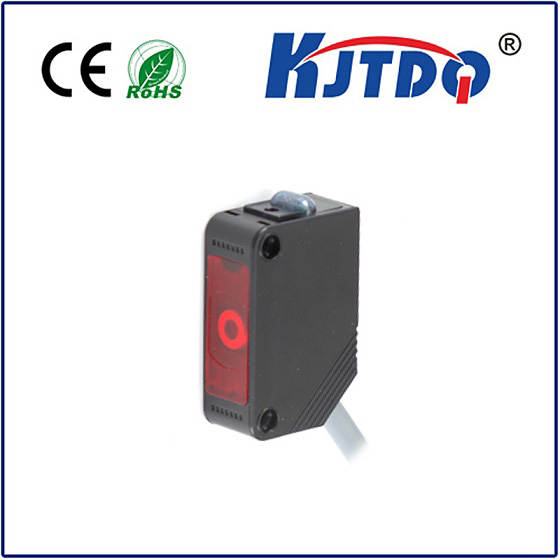
In the world of industrial automation, precision and reliability are non-negotiable. For engineers and system integrators tasked with designing robust sensing solutions, the choice of sensor can make or break an entire production line. Among the various technologies available, the square photoelectric sensor, particularly in a retro-reflective configuration, has emerged as a cornerstone for countless applications. This design combines a rugged form factor with a powerful detection principle, offering a unique blend of durability, ease of installation, and consistent performance that cylindrical sensors often struggle to match.
The fundamental advantage of the square housing is its inherent stability and mounting versatility. The flat surfaces allow for secure and straightforward installation on machine frames, brackets, or enclosures. This design minimizes vibration-induced misalignment, a common issue in high-speed or heavy-machinery environments. When this robust housing is paired with retro-reflective sensing technology, the result is a highly effective and efficient detection system. In this setup, both the light emitter (typically an LED) and the receiver are housed in the same square unit. The sensor projects a beam of light towards a specialized retro-reflector, often a prismatic tape or a dedicated reflector plate. This reflector is designed to return the light beam directly back to its source, regardless of the angle of incidence within a specified range. The sensor's receiver detects this returned light. An object passing between the sensor and the reflector interrupts this beam, triggering an output signal.
This retro-reflective method offers significant benefits over other photoelectric modes. Compared to through-beam sensors, which require separate emitter and receiver units wired on opposite sides of the detection point, the retro-reflective setup simplifies wiring and alignment by needing only one electrical connection point—the sensor itself. The reflector is a passive component, requiring no power or maintenance. This translates to lower installation costs, reduced cabling complexity, and faster setup times. When compared to diffuse (proximity) sensors, which detect light reflected directly off the target object, retro-reflective sensors provide a much longer sensing range and are far less susceptible to variations in the target's color, texture, or reflectivity. A dark, matte-finished object that might be invisible to a diffuse sensor will reliably break the powerful, focused beam of a retro-reflective system.
The application scope for square retro-reflective photoelectric sensors is vast. They are indispensable in packaging lines for detecting the presence or absence of boxes on a conveyor, ensuring proper spacing and triggering downstream processes like labeling or sorting. In material handling, they monitor pallet heights, count items on a belt, or act as gate sensors for automated guided vehicles (AGVs). Their immunity to color variation makes them perfect for detecting transparent objects, such as glass bottles or plastic films, which can challenge other sensor types. The square design is also favored in washdown or harsh environments, as many models feature IP67 or higher ingress protection ratings, with stainless steel or robust polymer housings that resist corrosion from chemicals, oils, and high-pressure cleaning.
Selecting the right square photoelectric sensor for a retro-reflective application involves considering several key parameters. Sensing range is paramount; it must comfortably exceed the actual working distance to account for mechanical tolerances and environmental dust. The type of light source—red visible, infrared, or laser—affects beam visibility for alignment and its performance with specific materials. Output configuration (PNP/NPN, NO/NC) must match the control system's PLC input card. Modern sensors also offer advanced features like background suppression, which helps ignore a reflective background, and teach-in functionality for easy range setting. For challenging environments with heavy dust, steam, or vibration, models with powerful beam strength and robust housing are essential to maintain uninterrupted operation.
Ultimately, the integration of a square form factor with retro-reflective technology represents a mature and optimized solution for industrial sensing. It delivers a critical balance: the mechanical advantages of a stable, easy-to-mount housing and the operational advantages of a long-range, target-independent detection method. For system designers seeking to enhance reliability, reduce maintenance downtime, and simplify installation, specifying a high-quality square photoelectric sensor configured for retro-reflective duty is a proven strategy. It is a decision that pays dividends in consistent performance and long-term operational efficiency, forming an invisible yet vital link in the automated chain of modern manufacturing and logistics.