Проверка
Проверка
Проверка
Проверка
Проверка
Проверка
In the world of industrial automation and process control, photoelectric sensors are indispensable components. They are the silent workhorses, providing reliable detection and measurement for countless applications, from packaging lines and material handling to automotive assembly and safety systems. Understanding the different photoelectric sensor types is crucial for engineers, technicians, and system integrators to select the optimal solution for any given task. This guide delves into the core principles and the main categories of these versatile devices, moving beyond basic definitions to explore their practical implications.
At its heart, a photoelectric sensor operates by emitting a beam of light (visible red, infrared, or laser) and detecting changes in the received light signal. The interaction between the emitted light and the target object is what defines the sensor's type and capability. The three fundamental operating principles are through-beam, retro-reflective, and diffuse (proximity) sensing.
The first major type is the Through-Beam Sensor, also known as the opposed mode sensor. This system consists of two separate units: a transmitter and a receiver, positioned opposite each other. The transmitter continuously emits a light beam directly to the receiver. An object is detected when it breaks this beam, interrupting the light path to the receiver. This method offers the longest sensing ranges and highest reliability, as it is largely immune to the target's color, surface finish, or angle. It is the ideal choice for detecting small, opaque objects or for applications requiring precise detection over distances of several meters, such as in conveyor belt break detection or counting objects on a high-speed line.
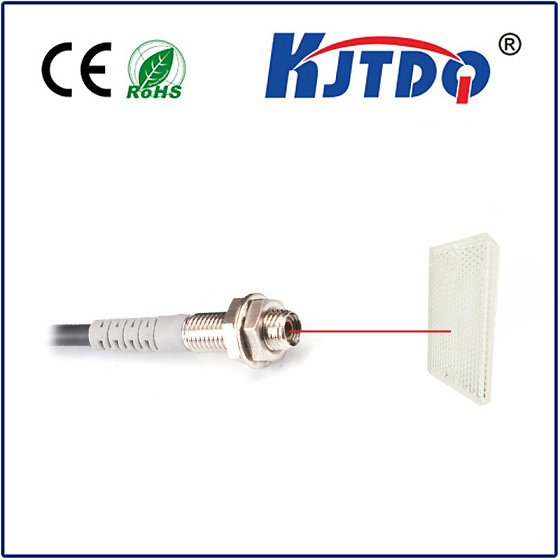
The second primary category is the Retro-Reflective Sensor. This type combines the emitter and receiver into a single housing. It works by projecting light towards a specialized reflector, often a corner-cube reflector made of prisms, which bounces the light directly back to the receiver. Detection occurs when an object interrupts this reflected beam. This design simplifies installation compared to through-beam sensors, as it requires wiring only on one side. However, it is important to note that shiny or highly reflective objects can sometimes mimic the reflector, causing false triggers. Modern retro-reflective sensors often incorporate polarization filters to mitigate this issue, allowing them to ignore most shiny targets. They are excellent for medium-range applications where through-beam installation is impractical.
The third and most common group is Diffuse Reflective Sensors, or proximity sensors. Like retro-reflective models, the emitter and receiver are in one unit. However, instead of using a separate reflector, they rely on the target object itself to reflect the emitted light back to the receiver. Detection is based on the intensity of the reflected light. This makes them highly dependent on the target's size, color, and surface texture; light-colored, matte objects are detected at greater distances than dark, shiny, or absorbent ones. Their key advantage is the need for only a single device and no reflector, making them perfect for detecting objects where mounting a receiver or reflector is impossible. They are widely used for presence detection, bottle cap inspection, and level sensing in bins.
Beyond these three core types, advanced variations have been developed to solve specific challenges. Background Suppression (BGS) Sensors are a sophisticated form of diffuse sensor. They use triangulation or time-of-flight principles to measure distance, allowing them to detect an object only within a precise, predefined range while ignoring any background beyond that point. This is invaluable for detecting objects on a conveyor belt while ignoring the belt itself or the machine bed behind it. Convergent Beam Sensors are another specialized diffuse type where the emitted beam is focused at a specific fixed distance, creating a very precise sensing point ideal for small part detection or edge guidance.
Fiber Optic Photoelectric Sensors represent a flexible solution for extreme environments. They use flexible fiber optic cables to guide light to and from a remote amplifier unit. The sensing head at the end of the cable can be extremely small, resistant to heat, chemicals, and vibration, and can be installed in tight spaces where a standard sensor housing would not fit. The amplifier, located safely away, can often be switched between through-beam, retro-reflective, and diffuse modes.
Choosing the right photoelectric sensor type is a systematic process. Key factors include the required sensing distance, the target object's characteristics (size, material, color), the environmental conditions (dust, moisture, ambient light), the required response speed, and the physical mounting constraints. For maximum reliability and long range with any object, through-beam is king. For easier installation with good range and where reflectors can be used, retro-reflective is optimal. For simple presence detection where the target is reasonably reflective and space is limited, a standard diffuse sensor suffices. When precise positioning or background rejection is needed, Background Suppression or Convergent Beam models are the answer.
By mastering the knowledge of these photoelectric sensor types and their underlying principles, professionals can make informed decisions that enhance system efficiency, reduce downtime, and ensure robust performance in any automated application. The correct sensor is not just a component; it is the foundation of reliable data acquisition and control.