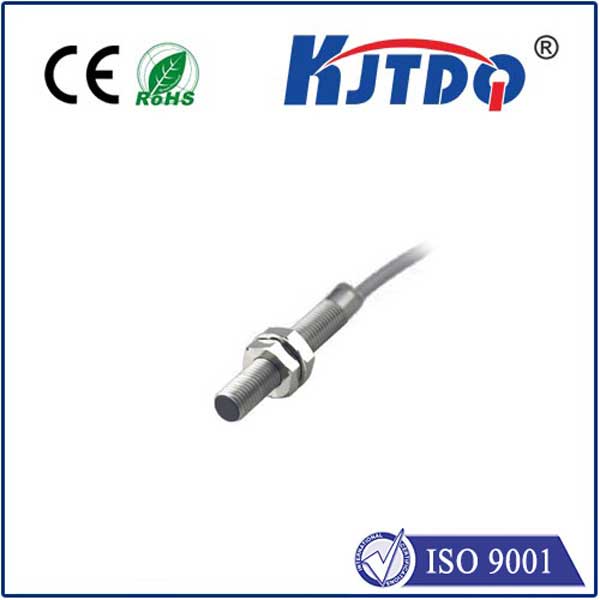
In the rapidly evolving landscape of industrial automation, achieving precise and reliable object detection is paramount for optimizing production lines, enhancing safety, and ensuring operational efficiency. The Proximity Sensor XS1M12MB230 emerges as a standout component engineered to meet these critical demands. This inductive proximity sensor is specifically designed for harsh industrial environments, offering unparalleled performance where accuracy and durability are non-negotiable.
The XS1M12MB230 sensor operates on the principle of electromagnetic induction. It generates an oscillating electromagnetic field from its sensing face. When a metallic object enters this field, eddy currents are induced within the object, causing a change in the oscillation amplitude. The sensor's internal circuitry detects this change and triggers a solid-state output signal. This non-contact detection method is ideal for applications involving fast-moving parts or where physical contact could cause wear, contamination, or damage. A key specification is its M12 form factor, which provides a compact and standardized design for easy integration into existing machinery and control systems. The threaded barrel housing ensures robust mounting and resistance to vibration, a common challenge in industrial settings.
One of the defining features of the XS1M12MB230 is its exceptional sensing range and repeat accuracy. Engineered for consistent performance, it reliably detects ferrous and non-ferrous metals at a defined distance with minimal variance, even under fluctuating temperature conditions or in the presence of ambient electrical noise. This reliability translates directly to fewer false triggers, reduced downtime, and more predictable machine cycles. The sensor is typically built with a nickel-plated brass or stainless-steel housing, offering excellent resistance to coolants, oils, and cutting fluids commonly found in machining, packaging, and assembly operations. Many models also feature integrated LED status indicators, providing immediate visual confirmation of power and output state, which simplifies installation, troubleshooting, and maintenance procedures.
The application scope for the Proximity Sensor XS1M12MB230 is vast. In automotive manufacturing, it is indispensable for tasks such as verifying the presence of engine components on a conveyor, counting pistons, or ensuring a robotic welder is in the correct position before initiating a cycle. Within the packaging industry, it monitors the passage of metallic lids or cans, ensuring proper filling and capping sequences. On material handling equipment, these sensors detect the position of pallets, elevator platforms, or automated guided vehicles (AGVs), enabling seamless logistics and warehouse automation. Furthermore, its robust design makes it suitable for use in heavy machinery, agricultural equipment, and even renewable energy systems like wind turbines for monitoring blade pitch or gearbox components.
Selecting the right sensor involves considering several parameters beyond just the model number. The sensing distance, or "switching distance," must be appropriate for the target object's size and the required installation clearance. The type of output—typically NPN (sinking) or PNP (sourcing)—must be compatible with the programmable logic controller (PLC) or input module being used. Environmental factors are crucial; the sensor's ingress protection (IP) rating, such as IP67, confirms its ability to withstand dust ingress and temporary immersion in water, ensuring longevity in washdown areas or outdoor applications. Electrical characteristics like operating voltage range (commonly 10-30V DC) and current consumption must align with the available power supply.
Installation best practices are straightforward but vital for optimal function. Ensuring the sensor is mounted securely to prevent movement, aligning it correctly with the target path, and maintaining the recommended lateral and axial clearance from surrounding metal objects (to prevent shielding effects) are fundamental steps. For demanding environments with extreme temperatures or strong electromagnetic interference, consulting the manufacturer's datasheet for specific derating or shielding recommendations is advised. Regular maintenance primarily involves keeping the sensing face clean from accumulated debris, metal chips, or grime that could attenuate the electromagnetic field and reduce effective range.
The Proximity Sensor XS1M12MB230 represents more than just a component; it is a critical enabler of modern, data-driven manufacturing. Its reliability forms the foundation for advanced Industrial Internet of Things (IIoT) systems, where sensor data feeds into analytics platforms for predictive maintenance and process optimization. By providing a dependable digital signal for the presence or absence of a metal target, it allows control systems to make real-time decisions, preventing jams, ensuring quality, and synchronizing complex automated sequences. For engineers and system integrators, choosing a proven and robust sensor like the XS1M12MB230 mitigates risk, reduces total cost of ownership through longevity, and contributes to building more resilient and efficient automated systems. Its combination of precision, ruggedness, and standardized design solidifies its role as a fundamental building block in the smart factory of today and tomorrow.