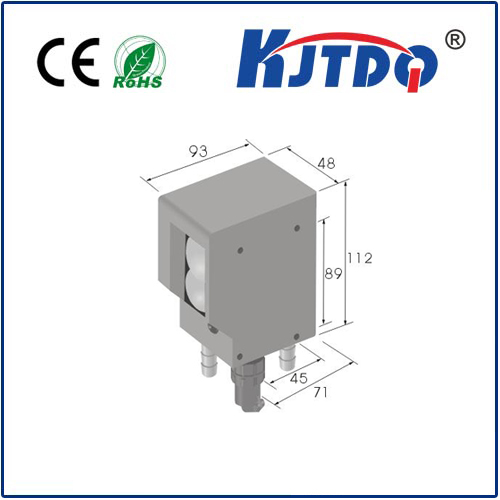
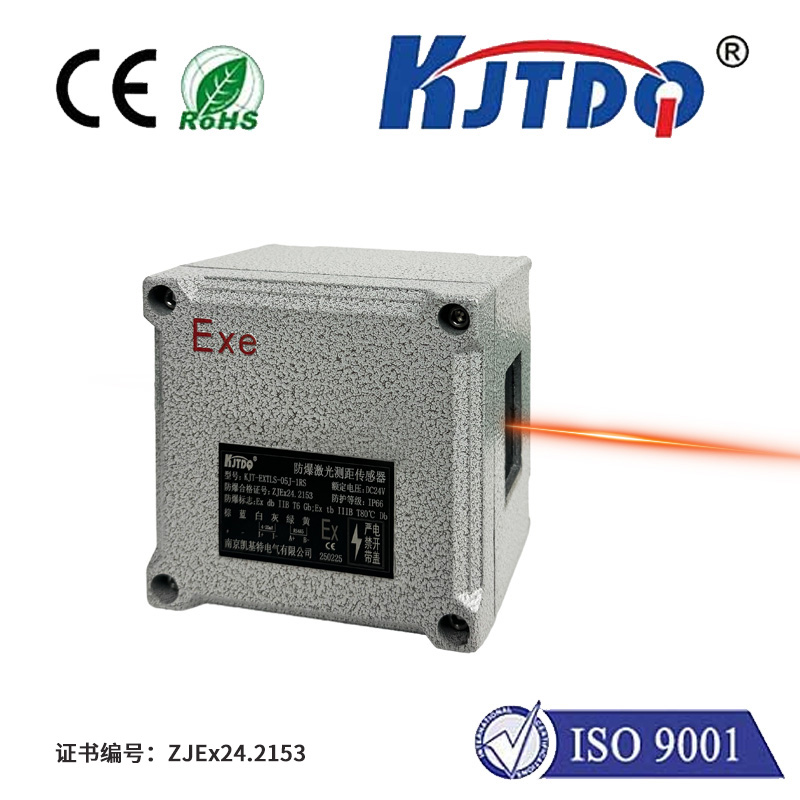
In today's fast-paced industrial and technological landscape, the demand for accurate, reliable, and non-contact measurement solutions has never been higher. At the heart of this revolution lies the laser range sensor, a sophisticated device that has transformed how we measure distance, position, and dimensions across countless applications. From the bustling floors of automated factories to the precise realms of robotics and construction, these sensors provide the critical data needed for efficiency, safety, and quality control.
A laser range sensor operates on a fundamentally simple yet powerful principle. It emits a focused beam of laser light toward a target object. The sensor then analyzes the light that returns, either by measuring the time it takes for the light pulse to travel to the object and back (Time-of-Flight or ToF method) or by evaluating the phase shift of a modulated laser beam. This data is processed to calculate the exact distance with remarkable precision, often down to sub-millimeter accuracy. Unlike traditional mechanical measurement tools, this process is instantaneous, non-invasive, and can be performed over considerable distances.
The advantages of integrating a laser range sensor into a system are manifold. First and foremost is its exceptional accuracy and repeatability, which are essential for tasks like part inspection, alignment, and assembly. Speed is another key benefit; measurements are taken in real-time, enabling high-speed automation and process control. Furthermore, because it is a non-contact technology, it can safely measure delicate, hot, moving, or otherwise inaccessible objects without risk of damage or wear. Modern sensors are also designed to be robust, capable of functioning in challenging environments with dust, vibration, or variable lighting conditions that would hinder other optical or mechanical methods.
The practical applications of laser range sensors are vast and continually expanding. In industrial automation, they are indispensable for robotic guidance, allowing arms to precisely locate and pick components. They monitor product dimensions on conveyor belts, ensuring every item meets strict quality standards. In the realm of logistics, they are used for warehouse inventory management, palletizing, and volume scanning. The construction and surveying industries rely on them for land measurement, building information modeling (BIM), and monitoring structural deformations. Even in emerging fields like autonomous vehicles, laser range sensors (often in the form of LiDAR) are crucial for creating real-time 3D maps of the surroundings to ensure safe navigation.
When selecting a laser range sensor for a specific project, several critical factors must be considered. The measuring range defines the minimum and maximum distances the sensor can handle effectively. Accuracy and resolution determine how precise the readings will be. The response time, or how quickly the sensor can take and output a measurement, is vital for dynamic applications. Environmental ratings, such as IP protection against dust and water, ensure longevity in harsh conditions. Finally, the output interface (e.g., analog voltage, digital IO, Ethernet, RS-232) must be compatible with the existing control system for seamless integration.
Looking ahead, the future of laser range sensing technology is bright. Trends point toward even smaller form factors, lower power consumption, and enhanced intelligence. Sensors are becoming smarter, with built-in data processing capabilities and connectivity for the Industrial Internet of Things (IIoT). This allows for predictive maintenance, where the sensor can diagnose its own health, and more sophisticated, networked measurement systems. As machine vision and artificial intelligence continue to advance, the fusion of laser measurement data with AI algorithms will unlock new levels of autonomous decision-making and process optimization.
In conclusion, the laser range sensor is far more than just a measuring tool; it is a foundational component of modern precision engineering. By delivering fast, accurate, and reliable distance data without physical contact, it empowers industries to achieve new heights of productivity, quality, and innovation. Whether for optimizing a simple assembly line or enabling a complex autonomous system, understanding and leveraging this technology is key to staying competitive in an increasingly automated world.