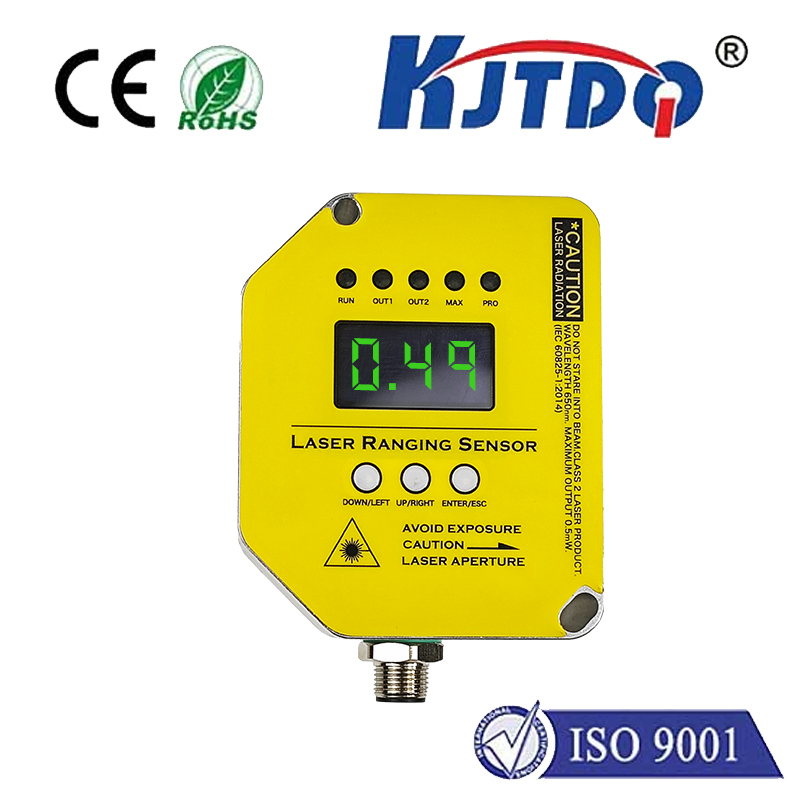
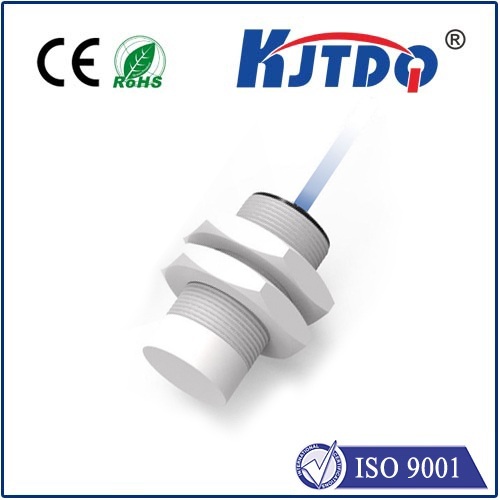
In the rapidly evolving landscape of industrial automation, the demand for sensors that deliver unwavering accuracy, robust performance, and long-term reliability has never been higher. Among the myriad of sensing solutions available, laser sensors stand out for their non-contact measurement capabilities and exceptional precision. The P3PC302 laser sensor emerges as a standout component in this category, engineered to meet the rigorous demands of modern manufacturing, quality control, and automated systems.
The core technology behind the P3PC302 is its advanced laser triangulation principle. This method involves projecting a focused laser beam onto a target object. The reflected light is then captured by a high-resolution receiver at a specific angle. By calculating the displacement of the reflected light spot, the sensor can determine the exact distance to the target with micron-level accuracy. This non-contact approach is crucial for applications involving delicate, hot, fast-moving, or otherwise inaccessible surfaces where physical probes would be impractical or damaging.
What sets the P3PC302 apart is its optimized design for challenging industrial environments. It typically features a compact and rugged housing, often rated with a high IP (Ingress Protection) classification for resistance against dust and water jets. This ensures stable operation on factory floors where oil mist, coolant, and particulate matter are common. Furthermore, its electronics are designed to minimize interference from ambient light and electrical noise, guaranteeing consistent readings even in less-than-ideal conditions.
The application spectrum for the P3PC302 laser sensor is remarkably broad. In automotive assembly lines, it is indispensable for tasks such as gap and flush measurement between body panels, ensuring perfect fit and finish. In electronics manufacturing, it precisely measures component height, coplanarity, and warpage on printed circuit boards (PCBs) before soldering. Within the packaging industry, it reliably detects the presence, position, and thickness of products on high-speed conveyor belts, facilitating accurate sorting and filling. Additionally, it plays a vital role in robotics for precise positioning and guidance, enabling robots to handle objects with dexterity and repeatability.
Ease of integration and user-friendly operation are key considerations for any industrial component. The P3PC302 is designed with this in mind. It often comes with intuitive setup tools or software that allows engineers to quickly configure measurement windows, thresholds, and output signals. Multiple output options, such as analog voltage/current, digital switches (NPN/PNP), and serial communication protocols (like RS-232 or IO-Link), provide seamless connectivity with Programmable Logic Controllers (PLCs), human-machine interfaces (HMIs), and data acquisition systems. This flexibility simplifies its adoption into both new and existing automation frameworks.
Beyond basic distance measurement, modern iterations of such sensors offer enhanced functionalities. Features like multi-point measurement, profile scanning, and advanced filtering algorithms allow the P3PC302 to handle complex inspection tasks. For instance, it can monitor the edge position of a continuous web of material or verify the dimensions of a machined part against a digital blueprint, becoming a critical tool for statistical process control (SPC) and quality assurance.
When selecting a sensor for a critical application, long-term performance and support are paramount. The P3PC302 is built with high-quality, industrial-grade components to ensure a long operational lifespan with minimal drift. Its design often allows for easy lens cleaning and maintenance without requiring complex recalibration. Choosing a reputable supplier for the P3PC302 also guarantees access to technical documentation, application support, and a reliable supply chain, reducing downtime and safeguarding production continuity.
In conclusion, the P3PC302 laser sensor represents a fusion of sophisticated optical engineering and practical industrial design. It translates the theoretical advantages of laser-based measurement into tangible benefits on the shop floor: increased production speed, enhanced product quality, reduced material waste, and lower maintenance costs. For system integrators, machine builders, and plant engineers seeking a dependable and precise sensing solution to overcome measurement challenges, the P3PC302 proves to be an intelligent investment that drives efficiency and fosters innovation in automated processes. Its role is not merely to detect but to enable a higher standard of precision in manufacturing.