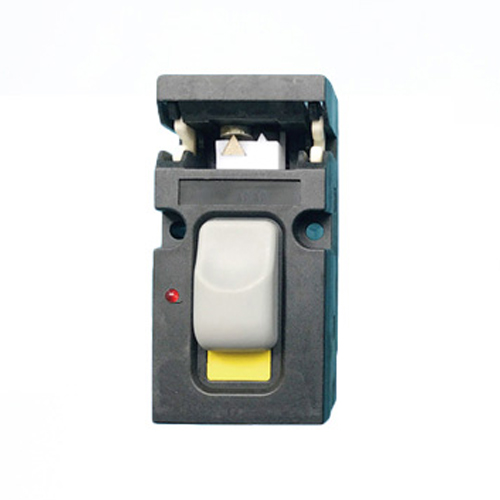
In the intricate world of electronic control and safety mechanisms, a small yet pivotal component often goes unnoticed: the door micro switch. These compact devices are fundamental to the reliable operation of countless systems, from household appliances to industrial machinery. A door micro switch, essentially a type of snap-action switch, is designed to detect the presence, position, or movement of a door, lid, or cover. Its primary function is to complete or interrupt an electrical circuit based on the physical state of the access point it monitors.
The operational principle of a door micro switch is elegantly simple but highly effective. It typically consists of an actuator, often a small lever or roller, connected to a set of internal electrical contacts. When a door is closed, the actuator is depressed, causing the internal contacts to change state—either opening or closing the circuit. This change in electrical state sends a critical signal to a control unit. For instance, in a microwave oven, this signal informs the system that the door is securely shut, enabling the magnetron to operate safely. Conversely, if the door is opened during operation, the switch immediately breaks the circuit, cutting power to potentially hazardous components. This fail-safe mechanism is a cornerstone of user safety.
The applications of door micro switches are remarkably diverse, underscoring their versatility. In the realm of home appliances, they are indispensable in washing machines, refrigerators, and dishwashers, ensuring doors are properly sealed before cycles begin. Within the automotive industry, these switches confirm that car doors, hoods, and trunks are fully closed, activating interior lights or triggering dashboard warnings. However, their most critical role is arguably in industrial settings. On factory floors, they serve as vital safety interlocks on machinery guards and electrical enclosures. They prevent equipment from starting unless protective doors are closed, safeguarding operators from moving parts, high voltages, or other dangers. This function is not merely convenient; it is often a legal requirement under occupational health and safety regulations.
Selecting the right door micro switch for a specific application requires careful consideration of several technical parameters. Engineers must evaluate the electrical rating, which defines the maximum voltage and current the switch can handle. The mechanical life, often rated in millions of cycles, indicates its durability under repeated use. Environmental factors are equally crucial; switches may need to be sealed against dust and moisture (with IP ratings) or constructed from materials resistant to corrosion, extreme temperatures, or chemical exposure. The actuation force—the pressure needed to trigger the switch—and the type of actuator (lever, roller, or simulated roller) must also match the mechanical action of the door it will monitor.
The evolution of door micro switches parallels advancements in automation and smart technology. Modern variants offer enhanced features such as higher precision, smaller form factors, and improved reliability. In smart home systems, the humble door micro switch becomes a sensor node, providing status data on windows, cabinets, or security gates to a central hub, enabling remote monitoring and automation routines. Their integration into the Internet of Things ecosystem demonstrates how a basic electromechanical component can form a critical link in a connected, intelligent network.
Despite the rise of solid-state sensors like Hall effect or optical sensors, the electromechanical door micro switch remains widely favored for many applications. Its key advantages include a tangible physical feedback, a clear audible "click" confirming operation, high current-carrying capacity relative to its size, and excellent resistance to electrical noise. It provides a direct, unambiguous signal that is easy for control circuits to interpret without complex signal conditioning.
In conclusion, the door micro switch is a quintessential example of engineering where simplicity breeds reliability and safety. Its unassuming presence belies its profound importance in preventing accidents, ensuring operational integrity, and enabling automated control. From ensuring a child cannot open a running washing machine to protecting a factory worker from a robotic arm, these switches perform silent, vigilant duty. As technology progresses towards greater automation and connectivity, the fundamental role of reliable, precise sensing components like the door micro switch will only become more entrenched, proving that sometimes, the smallest parts guard the most significant thresholds.