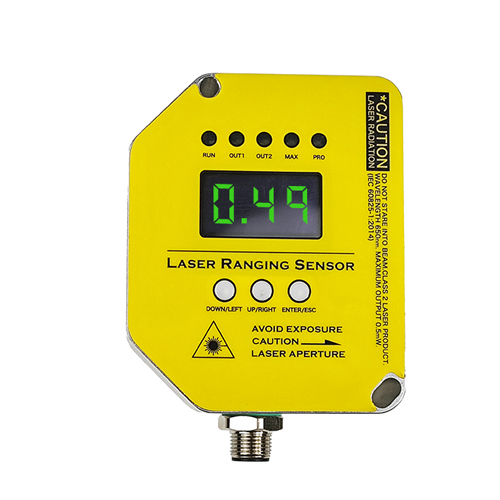
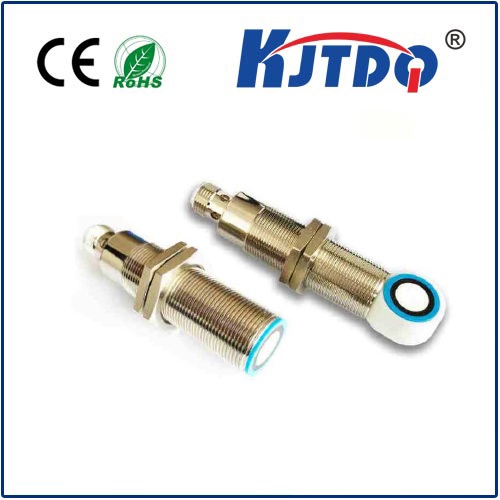
In today's fast-paced industrial and technological landscape, the demand for accurate, reliable, and efficient measurement solutions is higher than ever. The laser measure sensor module has emerged as a cornerstone technology, enabling unprecedented precision across a diverse range of applications. From advanced robotics and automated manufacturing to construction, logistics, and even consumer electronics, these compact yet powerful modules are redefining how we perceive and interact with spatial data.
At its core, a laser measure sensor module operates on the principle of Time-of-Flight (ToF) or phase-shift measurement. It emits a focused laser beam towards a target object. The module then precisely calculates the time it takes for the reflected light to return to its receiver. This data is processed internally to deliver a highly accurate distance measurement. Modern modules integrate sophisticated optics, high-speed processors, and stable laser diodes into a single, often miniaturized, package. This integration is key to their versatility, allowing for seamless embedding into larger systems or use as standalone tools.
The advantages of utilizing a laser measure sensor module are manifold. First and foremost is accuracy. These devices can achieve sub-millimeter precision over significant distances, far surpassing traditional mechanical methods. Speed is another critical benefit; measurements are captured almost instantaneously, facilitating real-time data acquisition essential for dynamic processes like object detection on a conveyor belt or drone-based surveying. Furthermore, they are non-contact sensors. This means they can measure delicate, hot, moving, or otherwise inaccessible surfaces without any risk of damage or interference, a vital feature in quality control and hazardous environments.
The practical applications are vast and growing. In industrial automation, laser modules are the "eyes" of robotic arms, guiding precise picking, placing, and assembly. They enable collision avoidance and navigation for Autonomous Guided Vehicles (AGVs) within warehouses. In the construction sector, they are integral to modern total stations, laser rangefinders, and BIM (Building Information Modeling) processes, ensuring layouts and structures are built to exact specifications. Even in the realm of smart devices, from smartphones that can quickly scan a room's dimensions to smart home appliances that adjust based on spatial awareness, the underlying technology often involves a compact laser measure sensor module.
When selecting a laser measure sensor module for a specific project, several technical parameters require careful consideration. Measurement range defines the minimum and maximum distances the module can reliably handle. Accuracy and resolution determine the fineness of the data. The sampling rate, or how many measurements per second the module can take, is crucial for high-speed applications. Environmental factors like ambient light immunity, operating temperature range, and robustness against dust or vibration are also paramount for reliable performance in real-world conditions. Interfaces such as UART, I2C, or USB dictate how easily the module communicates with a host controller or system.
Looking ahead, the evolution of laser measure sensor modules points towards even greater miniaturization, lower power consumption, and enhanced intelligence. The integration of AI algorithms directly at the sensor level could allow modules to not only measure distance but also classify objects or detect specific patterns. As the Internet of Things (IoT) expands, these smart sensors will become ubiquitous data points, feeding precise spatial information into larger digital twins and automated systems.
In conclusion, the laser measure sensor module is far more than a simple distance meter. It is a fundamental enabling technology driving innovation in automation, safety, and efficiency. Its ability to deliver fast, precise, and contactless measurements makes it an indispensable component for engineers, developers, and professionals aiming to build smarter, more responsive, and more accurate systems for the future. By understanding its capabilities and integration points, businesses can leverage this technology to gain a significant competitive edge.