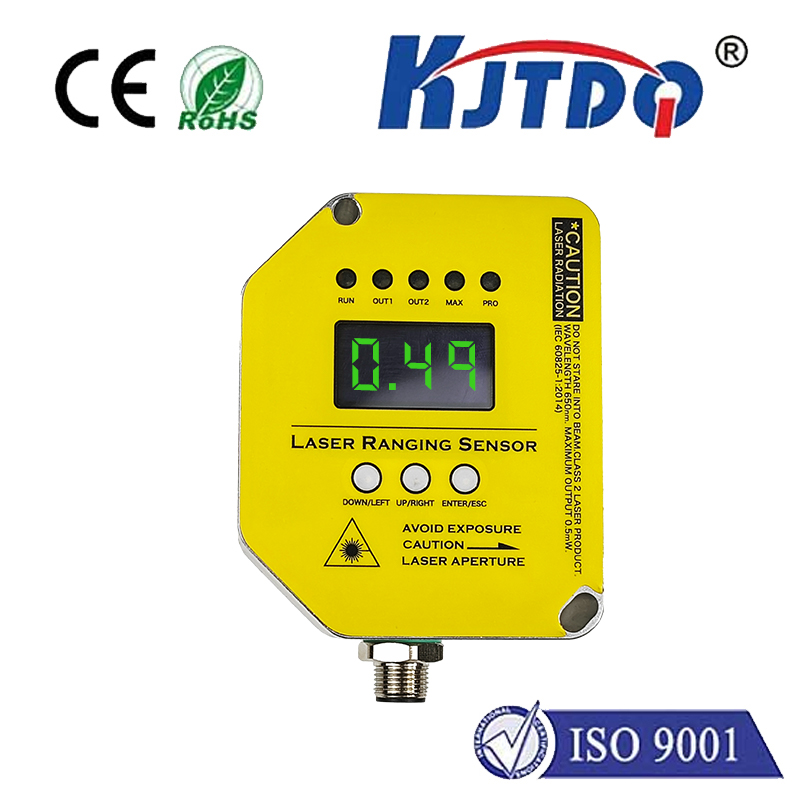
In the demanding world of industrial process control, achieving accurate and dependable level measurement is non-negotiable. From monitoring liquid levels in storage tanks to managing bulk solids in silos, the integrity of the entire operation often hinges on this single data point. For engineers and plant managers seeking a robust solution that seamlessly integrates into modern control systems, the laser level sensor with a 4-20mA output has emerged as a premier choice. This technology represents a significant leap forward, combining the pinpoint accuracy of laser measurement with the simplicity and noise immunity of the industry-standard analog signal.
The core principle behind a laser level sensor is Time-of-Flight (ToF) measurement. The device emits a focused pulse of laser light towards the target material's surface. The sensor's high-speed receiver then detects the reflection of this pulse. By precisely calculating the time difference between the emission and the reception of the light pulse, the sensor determines the distance to the material with exceptional accuracy. This non-contact method is a key advantage, eliminating issues related to material adhesion, corrosion, or mechanical wear that plague contact-based probes like floats or capacitive sensors. Whether measuring aggressive chemicals, hot liquids, or fine powders, the laser sensor maintains its performance without ever touching the product.
This is where the 4-20mA current loop interface becomes critical. The measured distance value is converted into a proportional analog current signal. A reading of 4 milliamps typically corresponds to the empty or low-level condition (or 0% of the calibrated range), while 20 milliamps represents the full or high-level condition (or 100% of the range). Any level in between is represented by a corresponding current value between 4 and 20mA. This standardized signal is the lingua franca of industrial automation. It can be transmitted over long distances with minimal signal degradation and is highly resistant to electrical interference common in plant environments. Programmable Logic Controllers (PLCs), Distributed Control Systems (DCS), and data acquisition systems are inherently designed to read and process these signals, making integration straightforward and cost-effective.
The synergy of laser technology and the 4-20mA output delivers a compelling set of benefits for operational excellence. First and foremost is precision. Modern laser sensors offer millimeter-level accuracy, enabling tight control over inventory and preventing costly overfills or run-dry situations. Their non-contact nature ensures minimal maintenance, as there are no moving parts to fail and no need for recalibration due to sensor coating or damage. The installation is remarkably simple, often requiring just a single mounting point on the top of a vessel, without the need for complex mechanical setups or process shutdowns. Furthermore, the high directivity of the laser beam allows for precise targeting in vessels with internal obstructions like agitators or heating coils, a scenario where ultrasonic waves might scatter and provide false readings.
Selecting the right laser level sensor for a 4-20mA application requires careful consideration of several factors. The most important is the material's properties. For clear liquids or highly reflective surfaces, most standard sensors perform well. However, for dark, absorbing liquids like crude oil or irregular, low-reflectivity solids like coal, a sensor with a higher laser power or specialized signal processing algorithms is necessary to ensure a reliable return signal. The process environment is another key factor; sensors are available with robust housings (often IP67 or higher) and specific safety ratings for use in hazardous areas. Finally, defining the required measuring range and the beam angle is essential to guarantee the laser spot hits the intended target area.
In practical applications, the versatility of the 4-20mA laser sensor shines. In the water and wastewater industry, they provide reliable level data in clarifiers and chemical dosing tanks. In the food and beverage sector, they monitor ingredients in mixing vessels without risk of contamination. In power generation, they track fly ash in silos. The analog signal allows for easy setup of alarm thresholds directly at the control system—for instance, triggering a pump at 18mA (90% full) and a high-level alarm at 19.5mA. This facilitates proactive process management and safety.
While initial investment might be higher than some traditional methods, the total cost of ownership for a laser level sensor with a 4-20mA output is frequently lower. The reduction in downtime for maintenance, the prevention of product loss through accurate measurement, and the longevity of the device contribute to a rapid return on investment. It is a future-proof solution that delivers the accuracy demanded by modern industry through a reliable, universally understood signal. For any operation prioritizing precision, reliability, and seamless system integration, this technology stands as an indispensable tool for optimal level control.