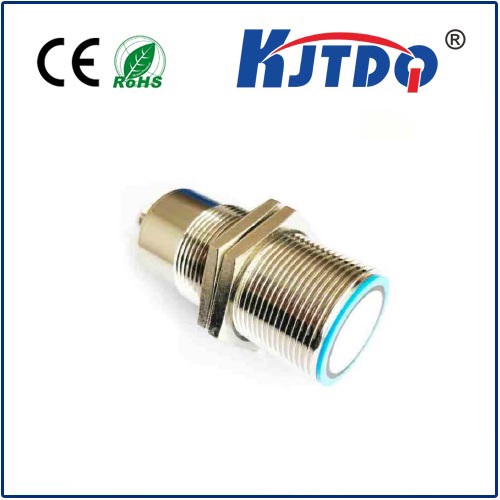
In the demanding world of industrial automation and process control, achieving precise, reliable, and non-contact distance measurement is not just an advantage—it's a necessity. This is where the KJTDQ Laser Distance Measuring Sensor operating on a 24V DC power supply becomes an indispensable tool. Engineered for robustness and accuracy, this sensor technology is transforming how industries approach measurement, positioning, and quality assurance.
The core of the KJTDQ sensor's operation lies in its sophisticated use of laser triangulation or time-of-flight principles. It emits a focused beam of laser light towards a target object. The light reflects off the surface and is captured by a high-resolution receiver within the sensor. By precisely calculating the angle of the returning beam or the time it takes for the light to travel, the sensor's internal processor determines the exact distance with remarkable speed and micron-level accuracy. The 24V DC power specification is a critical feature, as it aligns with the standard voltage used in most industrial control panels, PLCs (Programmable Logic Controllers), and automation systems. This ensures seamless integration without the need for additional, cumbersome power converters, reducing installation complexity and potential points of failure.
The applications for a 24V DC laser distance sensor are vast and varied. In manufacturing, they are pivotal for tasks such as precise thickness monitoring of materials on a production line, controlling the fill level in bottles or containers without physical contact, and ensuring robotic arms are positioned correctly for assembly or welding. In logistics and warehousing, these sensors automate pallet dimensioning, guide automated guided vehicles (AGVs), and manage inventory by monitoring stack heights. The construction sector utilizes them for alignment, leveling, and monitoring structural deformations. The 24V DC operation makes them inherently suitable for environments where safety and compatibility with other industrial equipment are paramount.
Choosing the KJTDQ 24V DC model offers several distinct advantages over other measurement methods. First is its unparalleled precision and repeatability, which far surpasses that of ultrasonic or mechanical probes, especially over longer ranges or with challenging surfaces. Second, the non-contact nature eliminates wear and tear, ensuring a long operational lifespan and consistent performance without maintenance downtime. It also prevents damage to delicate or sensitive target materials. Third, the high response speed allows for real-time measurement in high-speed processes, enabling immediate feedback and control loop adjustments. Finally, the 24V DC power input provides inherent noise immunity, making the sensor highly resistant to the electrical interference commonly found in industrial settings, thus guaranteeing stable and reliable data output.
When integrating a KJTDQ laser sensor into a system, several practical considerations ensure optimal performance. The choice of measurement range, from short to long distances, must match the application. The type of target surface is crucial; while lasers work excellently on most matte surfaces, highly reflective or transparent materials may require special filters or mounting angles. Environmental factors like dust, steam, or extreme temperatures should be addressed by selecting models with appropriate IP (Ingress Protection) ratings and operating temperature ranges. Proper mounting, alignment, and configuration via software interfaces are essential steps to unlock the sensor's full potential. Regular cleaning of the lens and ensuring a stable power supply from the 24V DC source are simple yet effective maintenance practices.
The evolution of laser distance sensing continues, with future trends pointing towards even smarter sensors. The integration of IO-Link communication in 24V DC models is a significant step, enabling digital parameter setting, advanced diagnostics, and seamless data exchange with higher-level control systems. This facilitates predictive maintenance and Industry 4.0 connectivity. Furthermore, advancements in laser safety (Class 1 or 2), miniaturization, and enhanced algorithms for handling difficult surfaces are making these sensors more versatile and user-friendly than ever.
In conclusion, the KJTDQ Laser Distance Measuring Sensor powered by 24V DC represents a cornerstone of modern industrial measurement. It delivers the critical combination of extreme accuracy, robust reliability, and easy integration that today's automated processes demand. By providing a precise digital eye for machinery and control systems, it enhances quality, boosts efficiency, and reduces waste across countless applications. For engineers and system integrators seeking a dependable solution for non-contact distance measurement, understanding and utilizing this powerful tool is key to driving innovation and maintaining a competitive edge in an increasingly automated world.