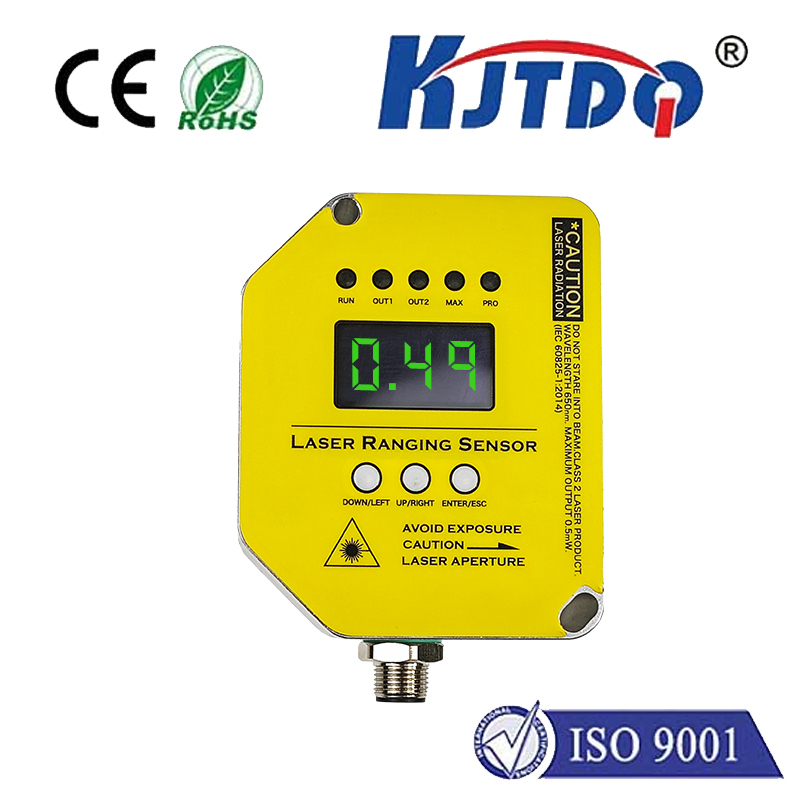
In the intricate world of industrial automation, achieving reliable and precise object detection is a cornerstone of efficiency and safety. Among the myriad of sensing technologies available, the reflective laser photoelectric sensor stands out as a premier solution for applications demanding high accuracy, long-range capability, and exceptional response times. Unlike traditional diffuse or through-beam sensors, this advanced device utilizes a focused laser beam, offering unparalleled performance in challenging environments.
The core principle of a reflective laser photoelectric sensor is elegantly straightforward yet technologically sophisticated. The sensor unit itself houses both a laser emitter and a receiver. The emitter projects a highly concentrated, coherent beam of laser light towards a dedicated reflector, typically a retro-reflective tape or prism. When an object passes between the sensor and the reflector, it interrupts this beam. The receiver detects this interruption and triggers a swift output signal. This "retro-reflective" method allows for a single, compact unit installation while maintaining the reliability benefits of a through-beam system, as the beam travels to and from a defined target.
The advantages conferred by the laser light source are transformative. First and foremost is precision. The laser's small, intense spot size enables the detection of minute objects or precise edges with sub-millimeter accuracy, which is critical in electronics assembly or precision part positioning. Secondly, it offers an extended sensing range. Laser-based sensors can reliably detect objects at distances far exceeding those possible with standard LED-based photoelectric sensors, sometimes spanning tens of meters. This makes them ideal for large-scale material handling, warehouse logistics, and crane positioning systems.
Furthermore, the coherent nature of laser light provides excellent resistance to ambient light interference. In settings with strong sunlight or bright factory lighting, a laser sensor maintains stable operation where other sensors might falter. Its high response speed, often in the microsecond range, ensures no fast-moving object on a high-speed production line goes undetected. Modern reflective laser sensors are also equipped with intelligent features like adjustable sensitivity, teach-in functionality for easy setup, and robust housing ratings (IP67/IP69K) for operation in dusty, wet, or washdown conditions.
The applications for reflective laser photoelectric sensors are vast and varied. In packaging machinery, they ensure precise carton flap detection and label positioning. In the automotive industry, they verify the presence of components on fast-moving assembly lines. They are indispensable in logistics for pallet detection and height control, and in semiconductor manufacturing for wafer handling and robot guidance. Their ability to see small objects at long ranges also benefits security systems and vehicle detection.
When selecting a reflective laser photoelectric sensor for a specific task, several factors must be considered. The required sensing distance and the size of the target object are primary determinants. Environmental conditions, such as the presence of dust, steam, or vibration, will dictate the necessary ingress protection rating. The output type (PNP/NPN, analog, or IO-Link) must be compatible with the existing control system. Finally, features like a visible red laser beam for easy alignment or background suppression capabilities can be crucial for complex installations.
In conclusion, the reflective laser photoelectric sensor represents a peak in non-contact sensing technology. By delivering a potent combination of pinpoint accuracy, long-range operation, and environmental resilience, it solves complex detection challenges that other sensors cannot. As automation systems evolve to become smarter and more demanding, the role of this precise and powerful sensing tool will only continue to expand, driving productivity and ensuring flawless operation across countless industries. Investing in the right laser sensor is an investment in the reliability and future-proofing of any automated process.