Проверка
Проверка
Проверка
Проверка
Проверка
Проверка
In modern industrial automation, reliable object detection remains a critical component for ensuring seamless operations, safety, and productivity. Among the diverse array of sensing technologies available, retro-reflective photoelectric sensors stand out for their versatility and robust performance in challenging environments. The KJTDQ series of retro-reflective photoelectric sensors exemplifies this technology, offering a sophisticated solution for precise detection across various applications.
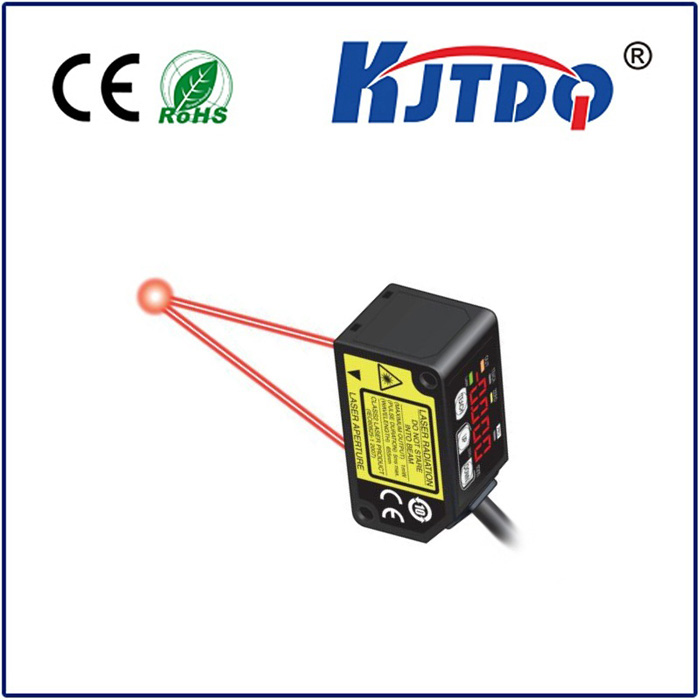
Unlike through-beam sensors that require separate emitter and receiver units, or diffuse sensors that rely on light reflected directly from the target, retro-reflective models utilize a single housing containing both the light emitter and receiver. This unit projects a light beam towards a specialized reflector, often a prismatic tape or corner-cube reflector, which returns the beam directly to the receiver along the same path. When an object interrupts this beam, the sensor triggers a detection signal. This design offers a significant advantage: it combines the long sensing range and high reliability of through-beam systems with the installation convenience of a single, unified device.
The core operational principle hinges on the quality of the reflector and the sensor's ability to distinguish the true reflected signal from background optical noise. Modern sensors, including the KJTDQ line, incorporate advanced modulated LED light sources. Instead of emitting a constant beam, these sensors pulse the light at a specific high frequency. The receiver is tuned to recognize only light pulsing at that exact frequency, effectively filtering out ambient light from factory lamps, sunlight, or other machinery. This modulation technology grants KJTDQ sensors exceptional immunity to optical interference, ensuring stable operation even in brightly lit or fluctuating light conditions.
Key performance characteristics define the utility of these sensors. Sensing range is paramount, and retro-reflective models typically offer ranges superior to diffuse sensors, often spanning several meters, making them ideal for monitoring conveyor belts, automated guided vehicles (AGVs), or large doorways. The KJTDQ series is engineered to maintain consistent performance across its specified range. Furthermore, the ability to detect a wide variety of objects is crucial. While highly reflective or transparent materials can pose challenges for some sensor types, the KJTDQ sensors can be finely tuned. Features like sensitivity adjustment or polarized filters are often integrated. A polarized filter allows the sensor to detect shiny objects like metal or glass by ensuring only light that has undergone a specific polarization shift at the reflector is recognized, ignoring direct glare from the target itself.
Practical application scenarios for KJTDQ retro-reflective photoelectric sensors are extensive. In packaging and material handling, they are indispensable for precise carton counting, bottle cap presence verification on filling lines, and detecting the position of pallets on high-speed conveyors. Their reliability makes them perfect for safety curtain applications on automated machinery or robotic cells, where any beam break signals an intrusion and halts movement. In the automotive assembly sector, they monitor the passage of vehicle bodies through paint shops or assembly stages. They are equally effective in warehouse automation for controlling automatic doors, managing inventory on storage retrieval systems, and ensuring AGVs navigate correctly along their paths.
Selecting the right sensor involves careful consideration of several factors beyond just range. The environmental rating is critical; KJTDQ sensors are available in robust housings with high Ingress Protection (IP) ratings like IP67, making them resistant to dust, water jets, and oils commonly found in industrial settings. The output type must match the control system—whether it requires a simple digital PNP/NPN signal, a relay contact, or an analog output proportional to distance. Response time is another vital specification, especially for high-speed production lines where milliseconds count. Ease of installation and alignment is also a notable benefit of the KJTDQ design, with many models featuring built-in alignment indicators (like LED status lights) that simplify setup and reduce downtime during maintenance or reconfiguration.
In conclusion, the integration of retro-reflective photoelectric sensor technology, as embodied by the KJTDQ series, provides a cornerstone for modern industrial automation. By delivering a balance of long-range detection, environmental resilience, and installation simplicity, these sensors address core operational challenges. Their advanced modulation for noise immunity and options for handling difficult-to-detect objects make them a versatile and dependable choice for engineers and system integrators aiming to enhance efficiency, safety, and reliability in their automated processes. As industries continue to evolve towards greater connectivity and precision, the role of such robust and intelligent sensing solutions will only become more pronounced.