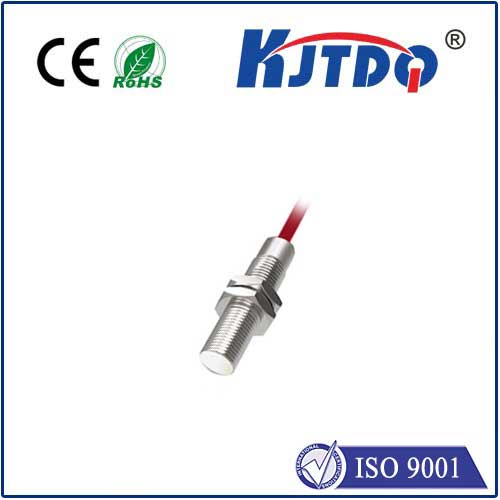
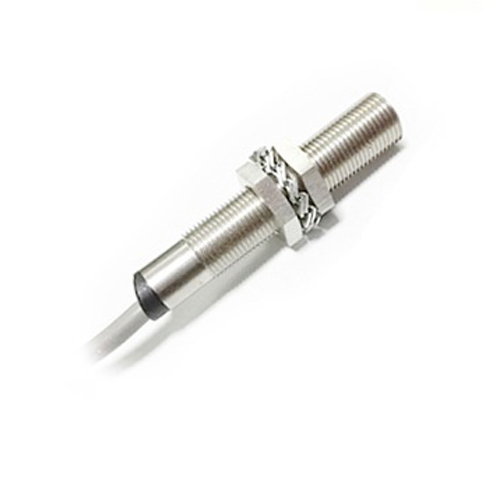
In the intricate world of industrial automation and electronic safety systems, the term "normally closed" (NC) is a fundamental concept, especially when applied to proximity sensors. A proximity sensor configured as normally closed operates on a principle that is both simple and critical for fail-safe design. Unlike its "normally open" (NO) counterpart, an NC proximity sensor maintains a closed electrical circuit in its default, non-activated state. This means current flows freely through the sensor's output when no target object is within its detection range. The crucial change occurs when a target enters the sensing field. The sensor activates and opens the circuit, interrupting the current flow. This transition from closed to open serves as the primary signal to a connected control system, such as a Programmable Logic Controller (PLC), indicating the presence of an object.
The inherent safety advantage of a normally closed configuration is a key reason for its widespread adoption. This design philosophy adheres to the "de-energize to trip" principle. In practical terms, if a critical failure occurs—such as a wire break, a loss of power to the sensor, or a physical malfunction—the circuit will inherently open. This open state mimics the active detection signal, triggering a safety shutdown or alert in the control system. This fail-safe characteristic is indispensable in applications where undetected failure could lead to equipment damage, production flaws, or personal injury. For instance, in a machine guarding application, an NC proximity sensor monitoring a safety gate will cause the machine to stop if the gate is opened (sensor activated) or if the sensor's wiring is severed (simulating activation). This ensures the highest level of operational safety.
Selecting between a normally closed and normally open proximity sensor depends entirely on the specific application's logic and safety requirements. The choice fundamentally alters how the control program is written. With an NC sensor, the input to the PLC is typically "TRUE" or "ON" when no object is present. The program is written to take a specific action (like stopping a motor) when that input switches to "FALSE" or "OFF." This logic often aligns more intuitively with safety protocols, where an abnormal condition (like an open circuit) should halt a process. Common applications for NC proximity sensors extend beyond safety gates to include part presence verification in assembly lines, end-of-travel limit detection in automated machinery, and position confirmation in robotic systems where a missing part or an out-of-bounds condition must immediately stop the cycle.
It is vital to understand that the "normally closed" designation refers to the electrical state of the sensor's output contacts in their resting, non-powered condition. This is a mechanical or solid-state relay concept. Modern proximity sensors, particularly 3-wire DC models, often allow users to select either a sinking (NPN) or sourcing (PNP) output, and within that, a normally open or normally closed logical function. This flexibility is usually configured via wiring or a selector switch, not by physically altering internal contacts. When integrating these sensors, technicians must carefully consult the datasheet to correctly interpret the wiring diagram and configure the PLC input logic to match the chosen sensor state, ensuring the system responds appropriately to the open or closed signal.
In summary, the normally closed proximity sensor is a cornerstone of reliable and safe automated system design. Its default closed circuit state provides a robust fail-safe mechanism, ensuring that system faults default to a safe condition. By intentionally opening the circuit upon detection, it offers a clear and secure signal for process control. Engineers and system integrators prioritize this configuration in scenarios where personnel safety and equipment protection are paramount. A clear grasp of the normally closed operation, its wiring implications, and its integration with control logic is essential for designing, troubleshooting, and maintaining efficient and secure industrial automation environments.