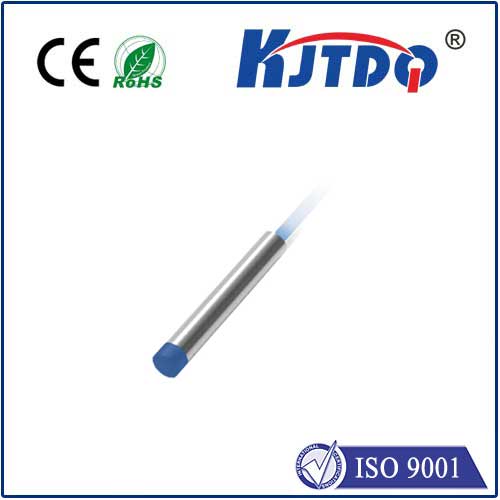
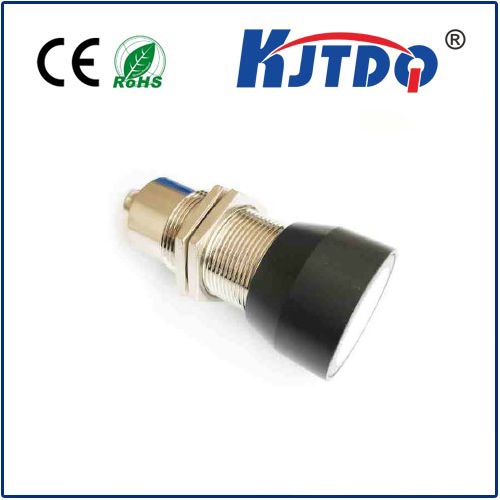
In the realm of industrial automation and precision measurement, the demand for reliable, accurate, and robust sensing solutions is paramount. The OMT600-R201-UEP-IO-V1-L laser sensor emerges as a standout component engineered to meet these rigorous demands. This comprehensive guide delves into the core features, operational principles, and diverse applications of this advanced sensor, providing essential insights for engineers, system integrators, and procurement specialists.
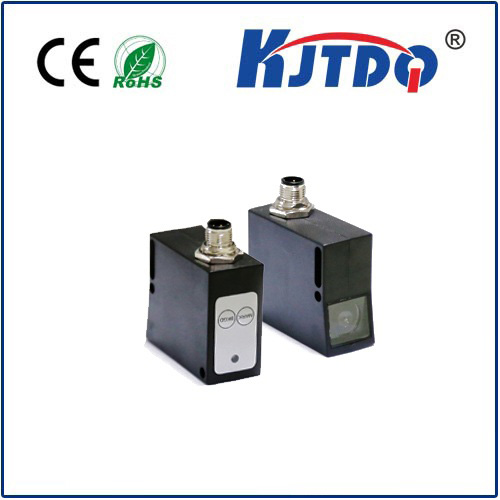
At its heart, the OMT600-R201-UEP-IO-V1-L is a state-of-the-art laser distance sensor. It utilizes a focused laser beam to perform non-contact measurements of distance, position, or presence of an object. The "R201" designation typically refers to a specific measuring range, which in this case is up to 2000mm, offering substantial flexibility for various setups. The "UEP" indicates a robust housing design, often signifying a cylindrical metal casing that provides superior resistance to environmental factors such as dust, moisture, and mechanical stress, ensuring stable performance in harsh industrial environments.
The "IO-V1-L" suffix is critical, detailing its interface and output configuration. This model is equipped with both digital I/O (Input/Output) and analog output capabilities. The integrated IO-Link communication protocol ("L") represents a significant advancement. IO-Link is a point-to-point serial communication protocol that enables bidirectional data exchange between the sensor and a master controller (like a PLC). This goes beyond simple switching signals; it allows for parameterization, real-time diagnostics, and detailed process data transmission. Users can remotely configure settings like the switching threshold, response time, or measurement mode without physical access to the sensor, drastically reducing downtime and simplifying maintenance.
The operational principle is based on laser triangulation or time-of-flight measurement, depending on the specific variant. In a typical setup, the sensor emits a laser dot onto the target object. The reflected light is captured by a receiver element within the sensor. By calculating the angle or the time difference between the emitted and received light, the sensor's internal processor accurately determines the distance to the object. This method ensures high precision, often in the sub-millimeter range, with excellent repeatability. The visible red laser beam also facilitates easy alignment and setup during installation.
The applications for the OMT600-R201-UEP-IO-V1-L are vast and span multiple industries. In automotive manufacturing, it is used for precise gap and flush measurement between body panels, ensuring quality control. Within the packaging industry, it monitors fill levels in bottles or containers and checks the height of stacked products on pallets. In material handling and logistics, it provides accurate positioning for robotic arms, detects object presence on conveyor belts, and measures coil or roll diameters. Its robust design makes it suitable for wood processing, metalworking, and even agricultural machinery, where it can monitor material dimensions or implement positions.
Key advantages of choosing this sensor include its exceptional accuracy and long-term stability, which are crucial for quality assurance processes. The IO-Link functionality future-proofs installations, enabling integration into Industry 4.0 and smart factory concepts for predictive maintenance and data analytics. The universal power supply compatibility (typically 10-30V DC) and multiple output options (PNP/NPN switching, analog 0-10V or 4-20mA) offer great flexibility for integration into existing control systems. Furthermore, the high switching frequency allows it to keep pace with fast-moving production lines without missing a beat.
When integrating the OMT600-R201-UEP-IO-V1-L, several best practices should be followed. Ensure the target object's surface properties are considered; highly reflective or dark, absorbent surfaces may require parameter adjustment using the IO-Link interface for optimal performance. Proper mounting is essential to avoid vibration interference, and keeping the lens clean from dust and debris will maintain measurement integrity. Utilizing the built-in teach-in function, often accessible via a button or through software, allows for quick and easy calibration to specific application points.
In conclusion, the OMT600-R201-UEP-IO-V1-L laser sensor represents a fusion of precision engineering and smart connectivity. It is more than just a measurement device; it is a intelligent node in an automated system, delivering critical data that drives efficiency, quality, and operational insight. For any project requiring dependable non-contact distance measurement with the benefits of digital communication, this sensor model stands as a compelling and technically superior choice.