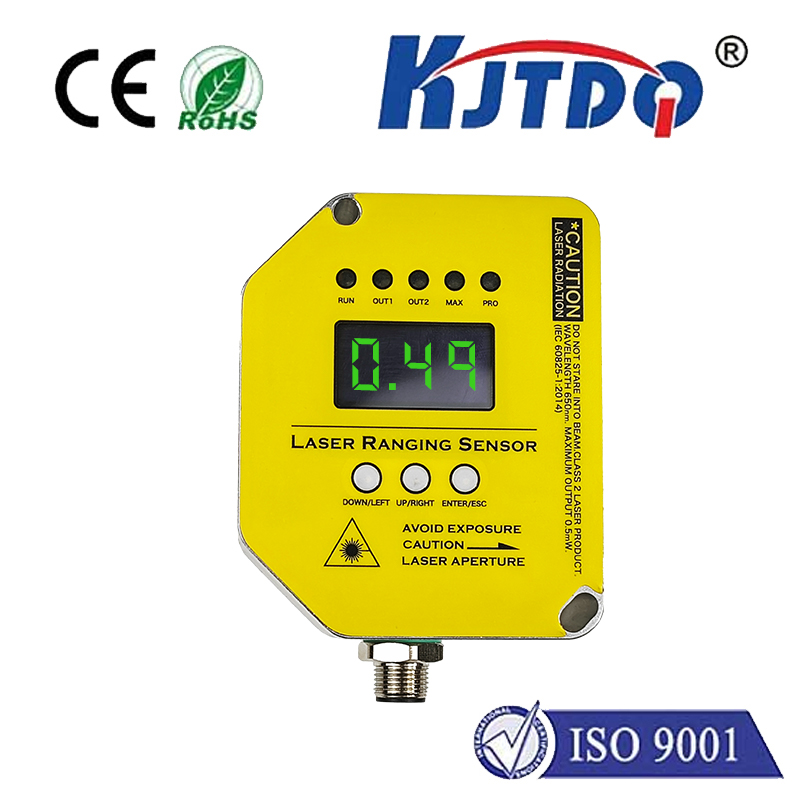
In today's fast-paced industrial and construction environments, accuracy and efficiency are paramount. The laser distance measuring sensor has emerged as a cornerstone technology, transforming how professionals approach measurement tasks. Unlike traditional tape measures or ultrasonic devices, these sensors utilize a focused beam of laser light to calculate distances with remarkable speed and precision.
The core principle behind a laser distance measuring sensor is time-of-flight or phase-shift measurement. The device emits a laser pulse towards a target. The sensor then calculates the distance by measuring the time it takes for the pulse to reflect back or by analyzing the phase shift of the modulated laser beam. This method allows for non-contact measurements, which is crucial for measuring hazardous, unreachable, or delicate surfaces. The result is data that is consistently accurate, often within millimeters, even over long ranges.
The applications for these sensors are vast and growing. In the construction industry, they are indispensable for tasks like calculating room dimensions, verifying floor levels, and estimating material quantities. Surveyors and civil engineers rely on them for topographic surveys and setting out building foundations. Within manufacturing and logistics, laser sensors are integrated into automated systems for quality control, robotic guidance, and inventory management, ensuring components are the correct size and positioned accurately. Even in fields like interior design, real estate, and forestry, these tools provide quick and reliable data.
Modern laser distance measuring sensors are packed with user-friendly features that enhance productivity. Many models offer Bluetooth connectivity, allowing measurements to be instantly transferred to smartphones or tablets and integrated into dedicated apps for sketching floor plans or creating detailed reports. Advanced functions include area and volume calculation, continuous tracking mode for minimum/maximum distance finding, and Pythagorean mode for calculating indirect heights. Their compact, rugged designs are built to withstand the rigors of job site use, with features like dust and water resistance.
When selecting a laser distance meter, several key specifications should be considered. The measuring range, which can vary from 50 meters to over 300 meters, must suit the intended applications. Accuracy, typically stated as ±1.5mm or better, is critical for precision work. Other factors include the type of display (backlit LCDs are essential for low-light conditions), battery life, and the availability of accessories like tripod mounts for stable long-range measurements.
The integration of laser distance sensors with other digital tools represents the future of measurement. Building Information Modeling (BIM) workflows increasingly utilize data from these sensors for accurate as-built models. When combined with 360-degree cameras or augmented reality platforms, measurement data can be visualized in entirely new ways, streamlining planning and execution phases of any project.
Ultimately, the laser distance measuring sensor is more than just a tool; it is a productivity multiplier. It eliminates common human errors associated with manual measurement, drastically reduces the time required for site surveys, and improves the overall quality of data upon which critical decisions are made. By delivering instant, precise, and reliable measurements, this technology empowers professionals across countless industries to work smarter, faster, and with greater confidence, laying the groundwork for innovation and excellence in every project.