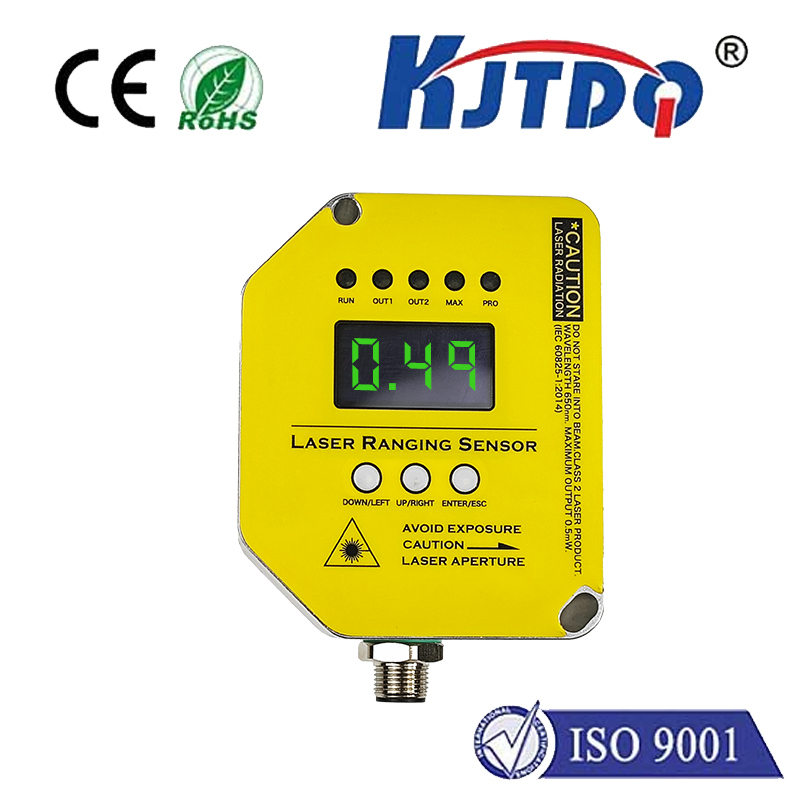
In the demanding world of precision engineering and automated manufacturing, the quest for accuracy is relentless. The introduction of a new generation laser sensor, capable of maintaining a remarkable distance measurement tolerance of 0.01mm, marks a significant leap forward. This isn't merely an incremental improvement; it represents a paradigm shift in how industries approach non-contact measurement, quality control, and process automation. The ability to reliably detect and measure with such minuscule variance opens doors to applications previously deemed too sensitive or costly for conventional sensors.
The core challenge in high-precision distance sensing has always been environmental stability and signal integrity. Traditional sensors often struggle with factors like ambient light interference, surface reflectivity variations, and thermal drift. The technology behind this 0.01mm tolerance laser sensor addresses these issues head-on. It employs a sophisticated modulated laser beam and advanced signal processing algorithms. Instead of relying solely on intensity, the system analyzes the phase shift of the returned light wave. This method is inherently less susceptible to the optical noise that plagues simpler triangulation or time-of-flight sensors at this scale. Furthermore, integrated temperature compensation circuits ensure that the sensor's calibration remains stable even in fluctuating industrial environments, a critical factor for maintaining the promised 0.01mm tolerance over time and across operating conditions.
The practical implications of this precision are vast and transformative. In the electronics industry, for instance, the placement of micro-components on printed circuit boards (PCBs) requires sub-micron accuracy. A sensor with 0.01mm tolerance provides the confidence needed to verify solder paste thickness, component coplanarity, and precise robotic placement in real-time, drastically reducing defects. In precision machining and tooling, this sensor enables in-process gauging. Manufacturers can now measure the diameter of a cutting tool or the depth of a machined feature *during* the operation, allowing for immediate corrective adjustments. This moves quality assurance from a post-production inspection step to an integrated, continuous process, eliminating waste and boosting throughput.
Another groundbreaking application is in the field of additive manufacturing, or 3D printing, particularly for metal parts. Layer-by-layer fabrication can lead to cumulative dimensional errors. Integrating this high-tolerance laser sensor into the printer head allows for real-time layer height monitoring and correction. It can detect warping or deviations as small as 0.01mm immediately after a layer is deposited, enabling the system to compensate in the next layer. This capability is crucial for producing functional aerospace or medical components where internal voids or surface imperfections at this scale can lead to catastrophic failure.
Beyond manufacturing, this technology empowers robotics with a new level of spatial awareness. Collaborative robots (cobots) working alongside humans can perform delicate assembly tasks, such as inserting a shaft into a bearing with a clearance of only a few hundredths of a millimeter. The laser sensor guides the robot's arm with the necessary feedback to achieve this fit without jamming or damaging parts. In automated warehousing, such precise sensing allows robotic arms to handle a wider variety of object shapes and sizes reliably, optimizing logistics and storage systems.
The journey to achieving and certifying a 0.01mm tolerance is rigorous. It involves calibration against internationally recognized standards, often using laser interferometers in controlled metrology labs. The sensor's performance is validated across its entire measuring range, under different surface materials (from matte black to polished metal), and at varying speeds. This comprehensive testing ensures that the stated tolerance is not a theoretical best-case scenario but a guaranteed performance parameter in real-world settings. For engineers and system integrators, this reliability translates into simpler design cycles, reduced need for redundant sensing systems, and lower total cost of ownership despite the advanced technology.
In conclusion, the breakthrough of a laser sensor operating with a 0.01mm distance tolerance is more than a technical specification. It is a key enabler for the next wave of industrial innovation. By providing a trustworthy, non-contact eye with unparalleled accuracy, it allows machines to perceive and interact with the physical world in ways that blur the line between human dexterity and automated efficiency. As industries continue to push the boundaries of miniaturization and quality, tools like this sensor will become indispensable, forming the foundational sensory layer for smarter, more precise, and more autonomous factories of the future.