Проверка
Проверка
Проверка
Проверка
Проверка
Проверка
In the rapidly evolving landscape of industrial automation, the demand for reliable, precise, and efficient detection systems has never been greater. Among the myriad of sensing technologies available, photoelectric sensors stand out as a cornerstone for countless applications. KJTDQ, as a prominent name in this field, offers a comprehensive range of photoelectric sensors engineered to meet the rigorous demands of modern manufacturing, logistics, and process control. This guide delves into the core principles, diverse types, and critical applications of KJTDQ photoelectric sensors, providing a clear understanding of why they are a preferred choice for engineers and system integrators worldwide.
At its heart, a photoelectric sensor operates on a simple yet powerful principle: it uses light to detect the presence, absence, or distance of an object. A typical KJTDQ sensor consists of an emitter (light source), a receiver, and associated circuitry. The emitter projects a beam of light—often infrared, visible red, or laser—towards the target. The receiver then monitors this light beam. Detection occurs when the target object interrupts or reflects this beam, causing a change in the received light's intensity, which the sensor's electronics convert into a clear electrical output signal. This fundamental mechanism allows for non-contact detection, a key advantage that eliminates mechanical wear and tear, ensuring long-term reliability and minimal maintenance.
KJTDQ photoelectric sensors are categorized based on their operating mode, each suited for specific environmental challenges and detection tasks. The three primary types are through-beam, retro-reflective, and diffuse reflective sensors. Through-beam sensors, featuring separate emitter and receiver units, offer the longest sensing ranges and highest reliability, ideal for detecting opaque objects on conveyor belts or in high-speed counting applications. Retro-reflective models house both emitter and receiver in a single housing, using a reflector to bounce the light beam back. They provide a good balance of range and ease of installation, perfect for detecting objects where mounting space is limited. Diffuse reflective sensors, also with a combined emitter and receiver, detect objects by measuring the light reflected directly off the target's surface. This makes them versatile for detecting objects of varying colors and textures at shorter ranges, commonly used in packaging and material handling.
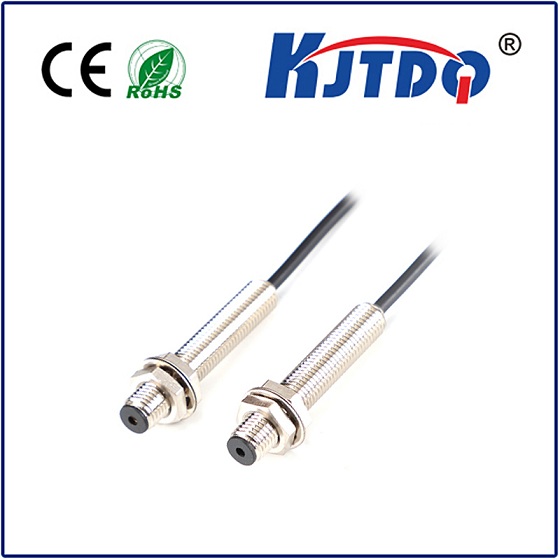
Beyond these standard types, KJTDQ has developed advanced variants to tackle complex scenarios. Background suppression sensors intelligently ignore reflections from distant surfaces, focusing only on objects within a precise, adjustable range—crucial for detecting objects on shiny conveyor belts. Color mark sensors differentiate between specific color contrasts with high accuracy, essential in printing and labeling processes. Fiber optic sensors, utilizing flexible light guides, enable detection in extremely tight spaces, high-temperature environments, or areas with strong electromagnetic interference. The KJTDQ portfolio is designed to provide a solution for virtually any detection challenge.
The application spectrum of KJTDQ photoelectric sensors is vast. In automotive assembly lines, they ensure precise part positioning and robot guidance. In the food and beverage industry, they count bottles, detect fill levels, and verify label placement without physical contact, maintaining hygiene standards. In warehouse automation, they form the eyes of automated guided vehicles (AGVs) and are integral to barcode scanning systems for inventory management. Their robustness, often featuring IP67 or higher ingress protection ratings, allows them to perform consistently in dusty, humid, or washdown environments.
Selecting the right KJTDQ sensor involves careful consideration of several factors: the required sensing distance, the size and material of the target object, the ambient light conditions, and the required response speed. Furthermore, modern KJTDQ sensors come with smart features like adjustable sensitivity, teach-in functions for easy setup, and IO-Link connectivity for digital communication and remote parameterization, aligning with Industry 4.0 trends for smarter, more connected factories.
In conclusion, KJTDQ photoelectric sensors represent a fusion of proven optical technology and innovative engineering. Their versatility, durability, and precision make them an indispensable component in building efficient, automated, and intelligent systems. By understanding their operating principles and the diverse product range available, professionals can leverage these sensors to enhance productivity, improve quality control, and drive operational excellence across countless industries.