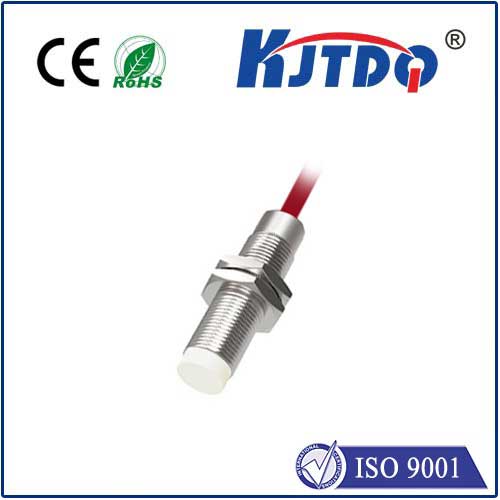
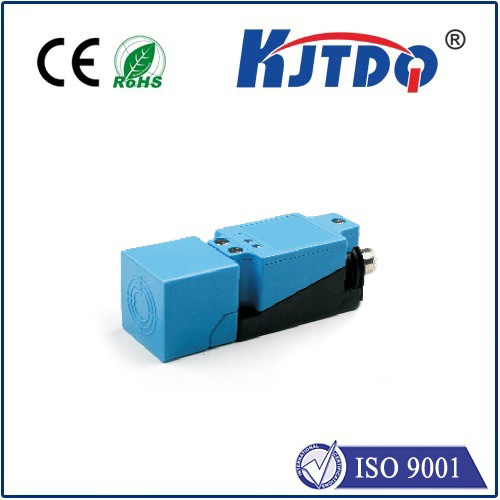
In the realm of industrial automation, precision, reliability, and durability are non-negotiable. Among the myriad of components that ensure seamless operations, the inductive proximity sensor stands out as a fundamental pillar. These sensors, often referred to by technical designations like KJTDQ in specific catalogs or systems, are the silent workhorses detecting the presence or absence of metallic objects without any physical contact. Their operational principle is elegantly simple yet profoundly effective. At their core, they generate an oscillating electromagnetic field. When a metallic target enters this field, eddy currents are induced within the metal, causing a change in the oscillation amplitude. This change is detected by the sensor's circuitry, which then triggers a solid-state output signal.
The advantages of using inductive proximity sensors, including KJTDQ series models, are extensive. First and foremost is their exceptional robustness. Encased typically in nickel-plated brass or stainless steel housings, they are inherently resistant to dust, dirt, oils, and coolants, making them ideal for harsh manufacturing environments like machining centers, assembly lines, and foundries. Unlike optical or capacitive sensors, they are virtually immune to environmental factors such as ambient light, steam, or accumulated grime on the sensing face. This translates to minimal false triggers and maximum uptime.
Furthermore, their non-contact nature eliminates mechanical wear and tear, ensuring a remarkably long operational life. They offer high switching frequencies, capable of detecting fast-moving objects on conveyor belts or counting metallic parts at impressive speeds. The sensing range, while specific to the sensor's size and design (typically a few millimeters to several tens of millimeters for standard models), is precise and repeatable. Modern variants come with various output configurations (PNP/NPN, NO/NC) and connection types (pre-wired cables or quick-disconnect connectors), providing flexibility for integration into diverse control systems, including PLCs.
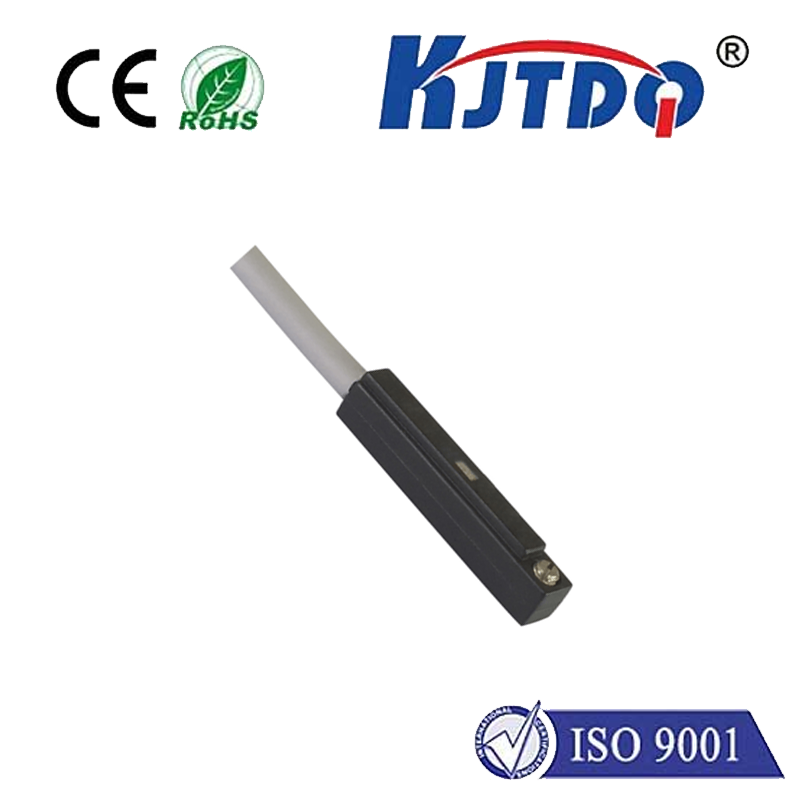
A key application area for inductive proximity sensors like the KJTDQ is in position verification. They are indispensable for confirming the presence of a metal part at a specific station in an assembly process, ensuring a robotic arm only proceeds when a component is correctly seated. They are also widely used for end-of-travel detection on pneumatic cylinders, providing critical feedback for machine cycle control. In packaging machinery, they detect metal lids or cans, synchronizing the filling and capping processes. In the automotive industry, they monitor the position of metal components during robotic welding, guaranteeing precision and quality.
When selecting an inductive proximity sensor for an application, several factors beyond the generic "proximity sensor inductive" search term must be considered. The housing material and shape (barrel, rectangular, ring-shaped) must suit the installation space. The sensing distance must be chosen with a safety margin to account for target material variations and mechanical tolerances. The target material itself is crucial; while ferrous metals like steel provide the longest sensing range, non-ferrous metals like aluminum, copper, or brass have a reduced effective range, a factor specified in sensor datasheets as a "reduction factor."
Installation is straightforward but requires attention to detail. Sensors must be mounted securely to avoid vibration-induced errors. In metallic environments, it is critical to maintain a minimum clearance between the sensor's sensing face and the surrounding metal mounting structure to prevent interference, a specification known as the "flush-mountable" or "non-flush" characteristic. Proper shielding and cable routing are also essential to protect the signal from electromagnetic interference from nearby motors or frequency drives.
The evolution of inductive sensing technology continues. Today's sensors are more compact, energy-efficient, and intelligent. Some advanced models feature IO-Link communication, enabling not just simple switching but also the transmission of diagnostic data like operating temperature, signal strength, and device health to higher-level control systems, facilitating predictive maintenance. This digital transformation elevates the humble proximity switch from a simple binary device to a smart node in the Industrial Internet of Things (IIoT) ecosystem.
In conclusion, the inductive proximity sensor, exemplified by reliable series such as KJTDQ, remains an indispensable component in modern industrial control. Its unwavering ability to detect metal objects reliably, swiftly, and without contact under challenging conditions forms the backbone of automated system safety, efficiency, and productivity. From simple limit switching to complex position feedback in smart factories, its role is both foundational and transformative, driving the relentless march of automation forward with silent, metallic certainty.