Проверка
Проверка
Проверка
Проверка
Проверка
Проверка
In the realm of industrial automation and electronic control, the proximity sensor stands as a fundamental component for non-contact detection. Among its various configurations, the NPN Normally Open (NO) type is particularly prevalent. This article delves into the intricacies of the proximity sensor NPN NO, explaining its operational principles, key characteristics, and typical application scenarios to provide a clear understanding for engineers, technicians, and enthusiasts.
At its core, a proximity sensor is a device that detects the presence or absence of an object within its sensing range without physical contact. It achieves this by emitting an electromagnetic field or a beam of electromagnetic radiation and looking for changes in the field or return signal. The "NPN" and "NO" designations specify its electrical output configuration and switching state.
Firstly, NPN refers to the type of transistor used in the sensor's output circuit. In an NPN output sensor, the switching element (the transistor) is connected between the output wire and the negative voltage supply (common ground or 0V). When the sensor is activated (detects a target), the NPN transistor switches ON, connecting the output line to the ground. This effectively allows current to sink from the load (e.g., a PLC input, relay) into the sensor's output, completing the circuit to the negative rail. This is often termed a "sinking" output. It is crucial to match this with a "sourcing" input on the controller for proper operation.
Secondly, Normally Open (NO) describes the default state of the sensor's output switch when no target is present. In an NO configuration, the output switch is open, meaning no electrical connection exists between the output terminal and the common terminal. The circuit is broken, and no current flows to the load. When a target enters the sensing range, the switch closes, completing the circuit and allowing current to flow. This action is analogous to a standard push-button switch that is off until pressed.
Combining these, a proximity sensor with an NPN NO output will have its output transistor in the OFF state (open circuit to ground) when idle. Upon detection, the transistor turns ON, sinking current to ground and signaling the detection event. This signal is typically interpreted as a logic 'low' or '0' by a connected programmable logic controller (PLC) or other control system when the input is wired to expect a sinking signal.
The advantages of using an NPN NO proximity sensor are significant. Its sinking output is a common standard in many regions and for many PLC models designed to accept current sinking inputs. The NO configuration is intuitive for safety and control logic; often, a "high" signal (or closed circuit) indicates an active or "run" state, which aligns with the NO sensor closing on detection. This setup is frequently used in applications like counting objects on a conveyor belt, detecting the position of a machine part, or initiating an action when an object is present.
When selecting and installing an NPN NO proximity sensor, several factors must be considered. The sensing distance, target material (ferrous metals are detected by inductive sensors, while capacitive sensors handle non-metals), environmental conditions (temperature, moisture, dust), and supply voltage compatibility are paramount. Correct wiring is essential: the brown wire (typically) connects to the positive DC supply, the blue wire to the negative/ground, and the black wire is the NPN output, which connects to the load. The load (e.g., the PLC input) is then connected between the positive supply and this black output wire. Always consult the manufacturer's datasheet for precise specifications and wiring diagrams.
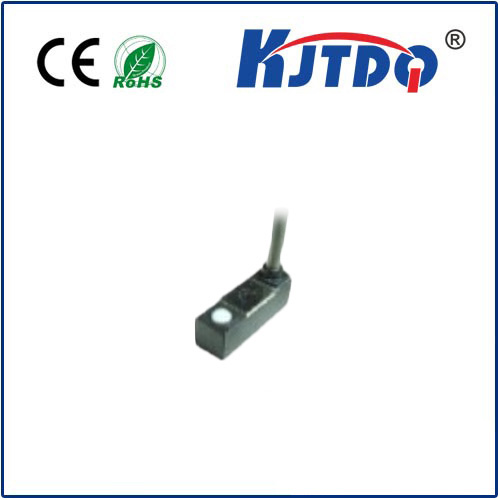
In practical applications, you might find NPN NO inductive proximity sensors on automated assembly lines detecting metal components, ensuring a robot arm only operates when a part is correctly positioned. In packaging machinery, they verify the presence of a product before sealing. Their reliability, fast response time, and lack of mechanical wear make them superior to mechanical limit switches in countless high-cycle operations.
In conclusion, the proximity sensor NPN NO is a versatile and widely adopted solution for automated detection tasks. Understanding its sinking output behavior and normally open switching logic is fundamental for designing, troubleshooting, and maintaining effective control systems. By choosing the correct sensor type and configuring it properly within the circuit, engineers can ensure robust, reliable, and efficient operation across a vast array of industrial and electronic applications.