In the intricate world of industrial automation and machine design, the choice of sensor output type is as critical as the sensing principle itself. Among the various options, the proximity sensor analog output stands out for its ability to provide a continuous, nuanced stream of data, offering a significant advantage over simple on/off digital signals. This capability makes it indispensable for applications requiring precision measurement, control, and monitoring.
Unlike a digital proximity sensor that merely indicates the presence or absence of a target within a fixed range, an analog output proximity sensor delivers a signal that varies proportionally with the distance to the target. Typically, this output is a voltage (e.g., 0-10V) or current (e.g., 4-20mA) signal. As the target moves closer or farther away, the output signal changes smoothly and continuously. This linear or predefined non-linear relationship between distance and output allows systems to interpret not just "if" a target is present, but "exactly where" it is within the sensor's sensing range.
The most common analog output types are the voltage and current loops. A 0-10V DC output is widely used in factory environments for its simplicity and compatibility with many programmable logic controllers (PLCs) and data acquisition cards. On the other hand, the 4-20mA current loop is renowned for its robustness in electrically noisy environments and its ability to transmit signals over long distances without significant signal degradation. The 4mA "live zero" also provides a clear indication of sensor health or wire breakage, a crucial feature for critical processes.
The applications for proximity sensors with analog output are vast and varied. In automotive assembly, they are used for precise gap and flush measurement between body panels. In packaging machinery, they monitor the diameter of a roll of material, triggering a replenishment alert before a run-out occurs. In hydraulic systems, they provide continuous feedback on piston rod position. They are also fundamental in robotics for delicate tasks like force feedback and edge guiding, where smooth, proportional control is necessary. Furthermore, in condition monitoring, an analog inductive or capacitive proximity sensor can track the vibration or eccentricity of a rotating shaft by monitoring the changing distance to its surface, providing early warning of potential bearing failure.
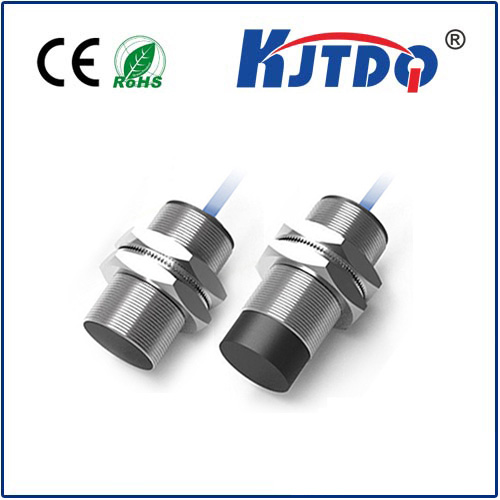
Selecting the right analog proximity sensor involves several key considerations. First, define the required sensing range and the necessary resolution—the smallest change in distance the system needs to detect. The sensor's linearity error, which defines how closely its output curve matches a perfect straight line, directly impacts measurement accuracy. Environmental factors are paramount: for sensing metallic objects in harsh, oily conditions, an inductive sensor with analog output is the standard choice. For detecting non-metallic materials like plastic, glass, or liquids, a capacitive analog sensor is required. The housing material (e.g., stainless steel, PBT plastic) must also withstand the specific environmental challenges, such as washdowns, chemicals, or physical impact.
Integrating these sensors into a control system requires connecting the output wires to the appropriate analog input module on a PLC or controller. Calibration is a vital step. Using known distance targets, technicians map the sensor's output signal (in volts or milliamps) to the actual physical distance in the control system's software, ensuring accurate real-world measurements. Proper shielding of cables is essential to minimize electromagnetic interference (EMI) that could distort the sensitive analog signal.
In summary, the proximity sensor analog output transforms a basic detection device into a powerful measurement tool. By delivering a continuous signal proportional to distance, it unlocks capabilities for precision control, process optimization, and predictive maintenance that are unattainable with binary sensors. For engineers and system designers aiming to enhance accuracy, flexibility, and intelligence in automated systems, understanding and utilizing analog output proximity sensors is a fundamental step toward building more responsive and efficient machinery.