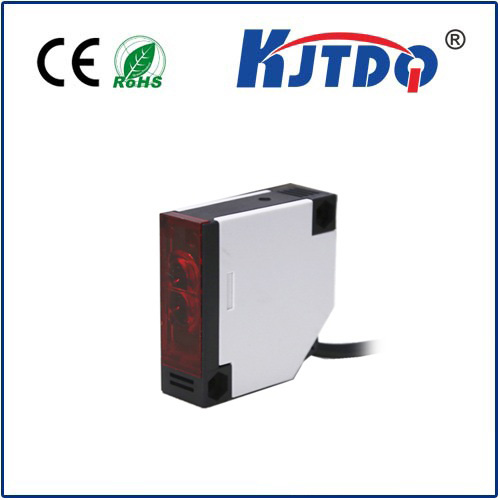
In industrial automation and control systems, photoelectric sensors are indispensable components for detecting the presence, absence, or distance of objects without physical contact. Among the various output configurations available, the NPN photoelectric sensor stands out for its specific electrical characteristics and widespread application. This guide delves into the fundamentals, working principles, and practical considerations of NPN photoelectric sensors.
At its core, a photoelectric sensor consists of a light emitter (usually an LED) and a receiver. The sensor detects changes in the received light beam caused by an interrupting object. The "NPN" designation refers to the type of transistor used in the sensor's output switching circuit. An NPN transistor, when activated, switches the negative or ground side of the load. Consequently, in a typical NPN sensor wiring scheme, the load (such as a PLC input or relay) is connected between the positive supply voltage and the sensor's output wire. When the sensor detects an object, the NPN transistor turns on, connecting the output wire to ground (0V), thus completing the circuit and allowing current to flow through the load.
This configuration is often described as a "sinking" output. It is crucial to match the sensor's output type (NPN sinking) with the input type of the controller. Many programmable logic controllers (PLCs) and devices in Europe and Asia are designed to work with PNP (sourcing) inputs, but a significant number, especially in certain regions and applications, utilize NPN-compatible inputs. Understanding this compatibility is the first step in correct sensor selection and system integration.
NPN photoelectric sensors come in three primary sensing modes: through-beam, retro-reflective, and diffuse. Through-beam sensors offer the longest sensing range and highest reliability, with separate emitter and receiver units. An object is detected when it breaks the beam between them. Retro-reflective sensors house both emitter and receiver in one unit, using a reflector to bounce the light back. They are easier to install than through-beam models. Diffuse sensors, also self-contained, detect objects by measuring the light reflected directly from the target's surface, making them ideal for detecting non-reflective materials or at shorter distances.
The advantages of using NPN photoelectric sensors are numerous. They provide fast, non-contact detection suitable for fragile, small, or rapidly moving objects. Their solid-state design ensures long life and high reliability with no mechanical wear. Modern NPN sensors are highly resistant to environmental factors like dust, moisture, and vibration, thanks to advanced housing materials and optical designs. They can detect a vast range of materials, from metals and plastics to glass and liquids, depending on the chosen model and technology (e.g., background suppression for precise range detection).
When implementing an NPN photoelectric sensor, several key factors must be considered. First is the operating voltage range, commonly 10-30V DC. Second is the output current capacity; ensure it can handle the current required by the connected load. The sensing range, response time, and light source (red visible, infrared, laser) must be matched to the application's speed and precision needs. Environmental conditions such as temperature extremes, washdown requirements, or exposure to chemicals dictate the necessary housing rating (e.g., IP67). Finally, the output state—light-on or dark-on—defines whether the sensor activates when it receives light or when the beam is blocked, which must align with the control logic.
Typical applications span across all industries. In packaging, NPN sensors count bottles on a conveyor. In material handling, they detect the position of pallets. In assembly, they verify the presence of components. In automotive manufacturing, they ensure robotic tools are correctly positioned. Their versatility makes them a fundamental building block in creating efficient, automated processes.
Troubleshooting often involves checking the power supply, ensuring the load is correctly wired in series with the NPN output to positive voltage, verifying the sensing alignment, and cleaning the lens. Always consult the manufacturer's datasheet for specific wiring diagrams and specifications.
In conclusion, the NPN photoelectric sensor is a robust, versatile, and critical component in modern automation. Its sinking output configuration provides a reliable interface for a wide array of control systems. By carefully selecting the sensor based on the object, environment, and electrical requirements, engineers can build detection systems that enhance productivity, safety, and quality in countless industrial applications. As technology advances, these sensors continue to evolve, offering even greater precision, connectivity, and intelligence for the factories of the future.